

Español
← Explore

Research updates & guides

Clear guides to peptide formulas, measurements, and research sources.

2026-10-16

Save the article. Keep the source.

Build a small reading list you can actually revisit. Learn what Save keeps, where to find it, and how to share the right language link without sharing your personal app data.
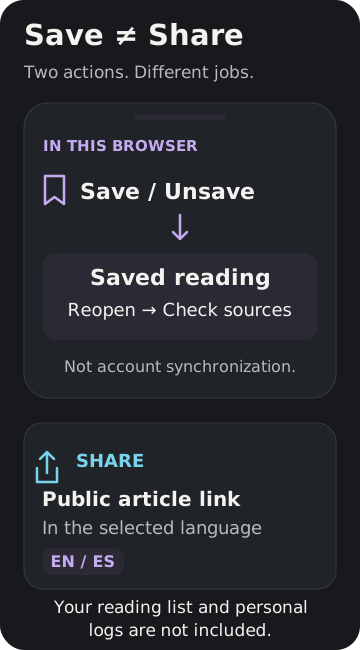
A conceptual reading workflow, not a screenshot. Save keeps an article bookmark in this browser. Saved reading helps reopen the guide, where you can check dates and sources. A separate Share path produces a public article link in the selected language; it does not send the reading list or personal logs. The reading list is not account synchronization or an offline download.
2026-10-15

Forzinity: what accelerated approval does—and does not—mean

A real approval can still leave an important question to confirm. Read the specific product, patient group and evidence behind the elamipretide headline.
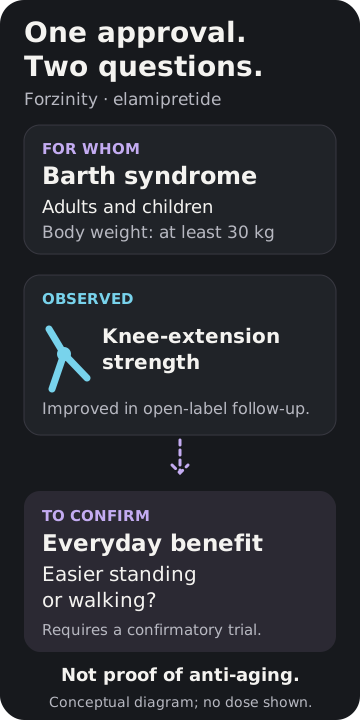
A conceptual evidence bridge for Forzinity. Its approval applies to muscle strength in adults and children with Barth syndrome weighing at least 30 kilograms. Improved knee-extension strength was observed during open-label follow-up. A dashed connection leads to a separate question: whether that predicts patient benefits such as standing or walking more easily, which requires a confirmatory trial. A stylized knee is a teaching icon, not a patient image or anatomical model.
2026-10-14

More milligrams does not mean a stronger peptide

Milligrams tell you how much material is present. They do not rank different peptides by benefit, biological activity or safety.
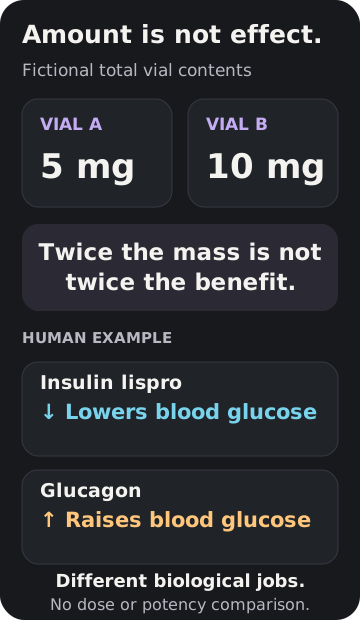
A conceptual comparison separates declared vial contents from biological effect. A fictional vial A labeled 5 mg and vial B labeled 10 mg cannot be ranked by potency from those amounts. A separate human example shows insulin lispro lowering blood glucose and glucagon raising it through liver glucose release. No equal-dose comparison, molecular structure or clinical result is depicted.
2026-10-13

Registered, completed, published: three different milestones

A trial record can show what was planned, where a study stands and whether results were posted. Those are different facts—and none alone says a peptide worked.
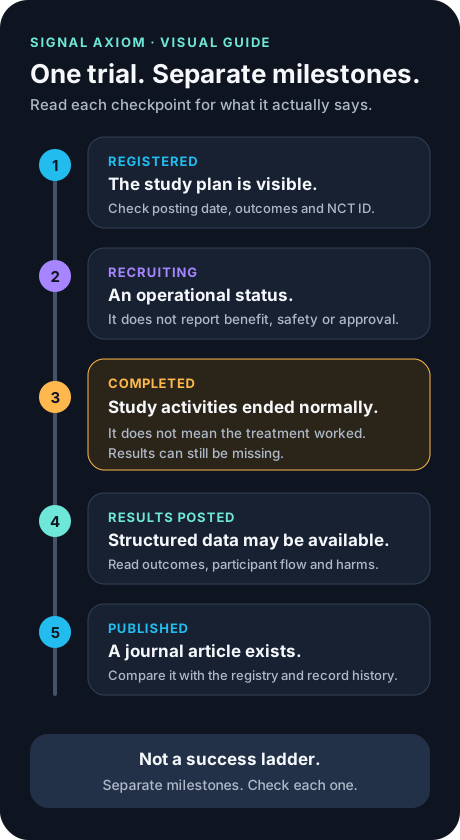
A five-step trial milestone path: registered means the study plan is visible; recruiting is an operational status; completed means planned study activities ended normally, not that the treatment worked; results posted means structured outcome tables may be available; published means a journal article exists and should be compared with the registry. The milestones are separate checkpoints, not a success ladder.
2026-10-12

Who was studied? The answer sets the boundary

Randomization can make a comparison fair inside a trial. It does not automatically tell us what happens in people who were never enrolled.
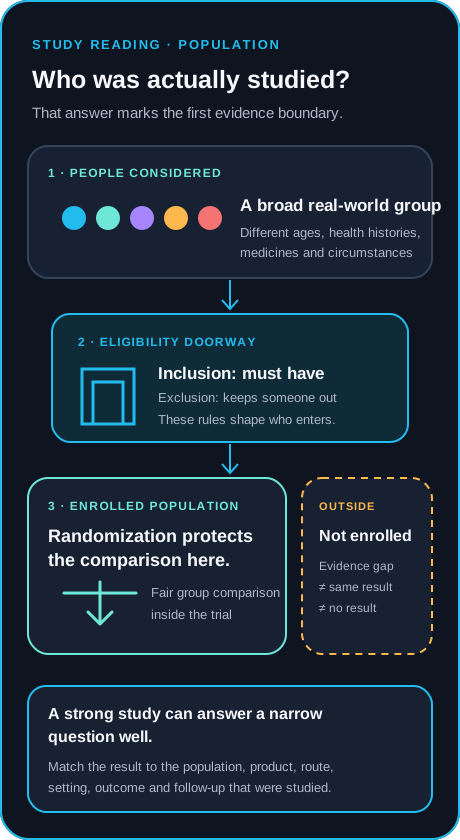
A study-population diagram. A broad group reaches an eligibility doorway. Inclusion and exclusion criteria determine who enters the enrolled group. Randomization protects the comparison within that group. People outside the eligibility doorway remain an evidence gap, not proof of the same result or no result.
2026-10-11

Endogenous, analog, product: three different questions

A peptide your body makes, a designed analog and a finished product may share a biological pathway. They are not interchangeable evidence.
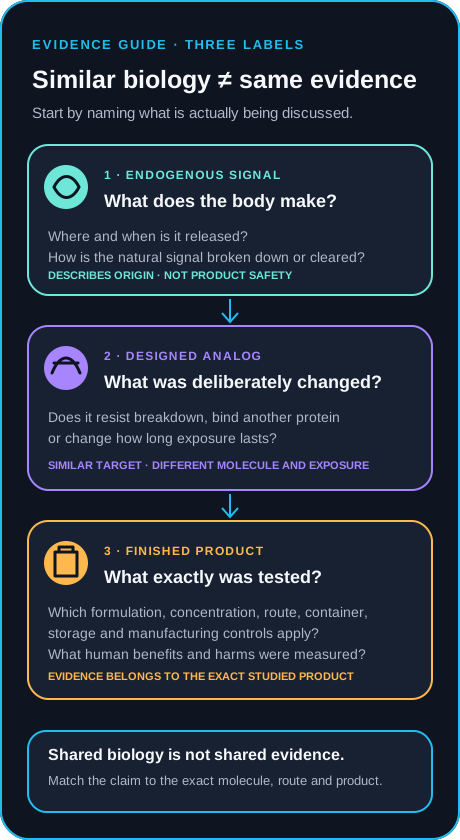
A three-part evidence guide. Endogenous asks what signal the body makes and how it is cleared. Analog asks what was changed and how that changes exposure. Product asks what exact formulation, route, quality controls and human evidence apply. The conclusion says shared biology is not shared evidence.
2026-10-10

A mechanism is a map—not a clinical result

Receptor binding, cell signals and animal findings can explain why an idea is worth testing. They do not, by themselves, show that people benefit.
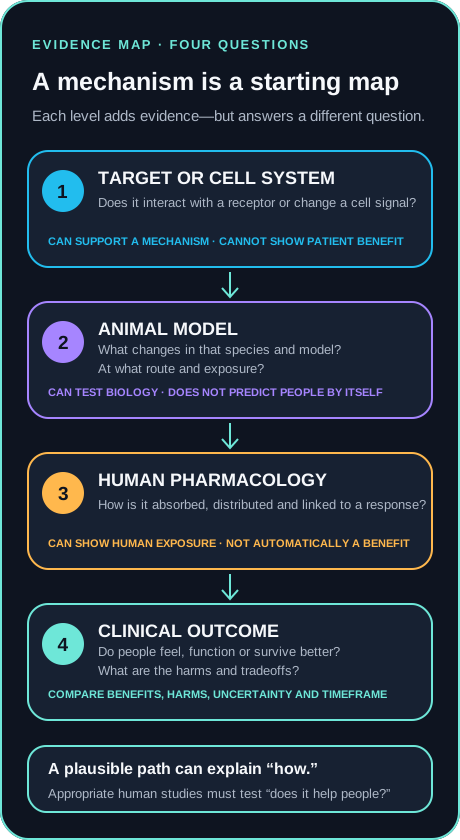
An evidence map separates four questions: whether a molecule interacts with a target in a laboratory system, what changes in an animal model, what the human body does with the product, and whether people experience a meaningful benefit or harm. Each step answers a different question.
2026-10-09

“No adverse events reported” does not mean proven safe

A safety statement is only as wide as the study window: who was observed, how many people, for how long and how harms were collected.
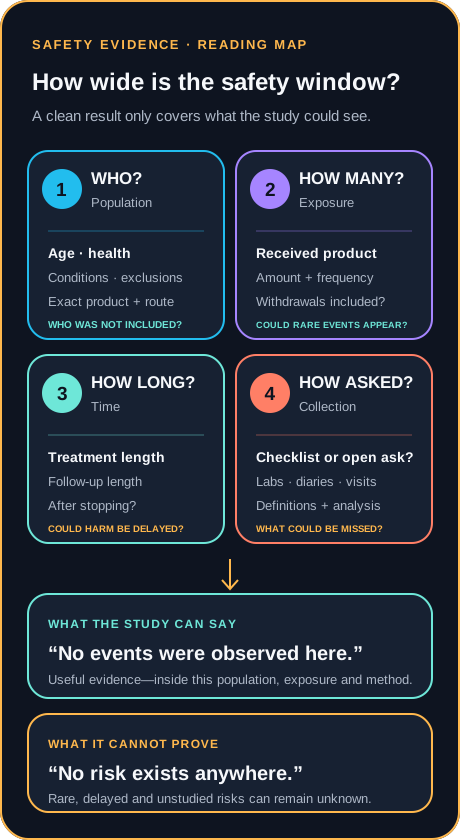
A four-part safety window asks who was studied, how many people were exposed, how long treatment and follow-up lasted, and how adverse events were collected. The conclusion states that no events observed inside one study window does not mean no risk exists outside it.
2026-10-08

“Statistically significant” is not the whole result

Before a p-value becomes a headline, ask how large the effect was, how uncertain the estimate is and whether the outcome matters.
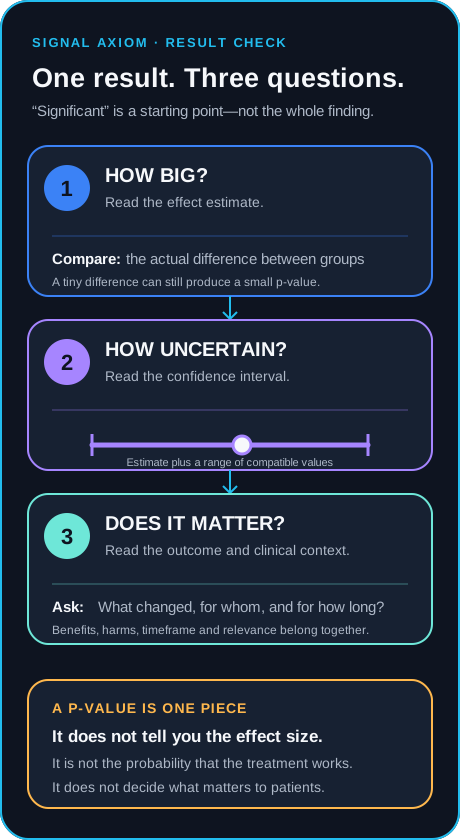
Three-question map for reading a study result. First ask how large the effect is and read the difference between groups. Next ask how uncertain the estimate is and read the confidence interval. Then ask whether the outcome matters and review the clinical context. A note explains that a p-value is not the effect size, the probability that a treatment works, or a decision about patient importance.
2026-10-07

Lyophilized means freeze-dried—not automatically stable or sterile

A dry cake tells you how water was removed. It does not tell you the vial's identity, potency, sterility, storage rules or discard time.
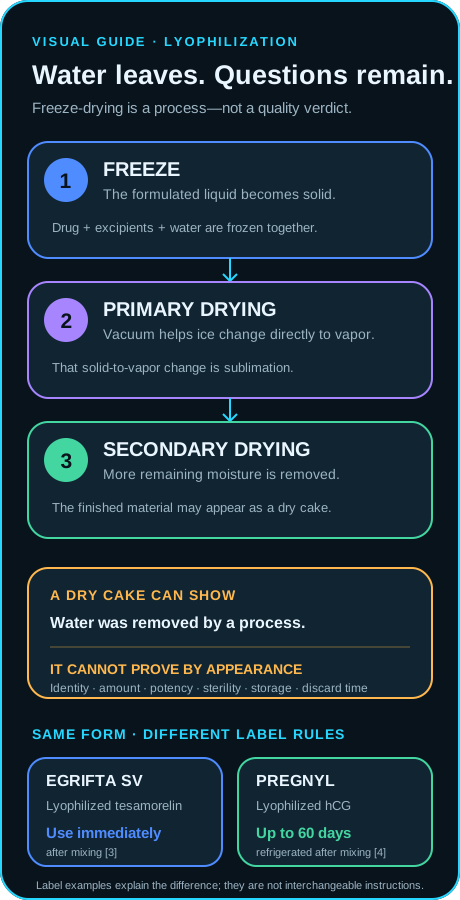
Three-step lyophilization map. First the formulated liquid is frozen. Next, vacuum helps ice change directly to vapor during primary drying. Secondary drying removes more remaining moisture. A dry cake cannot prove identity, amount, potency, sterility, storage or discard time. Official labels then contrast EGRIFTA SV, used immediately after mixing, with PREGNYL, refrigerated for up to 60 days after mixing.
2026-10-06

Randomized, double-blind, placebo-controlled: what those words do

Random assignment, masking and a comparison group solve different problems. Learn what each protects against—and what none proves alone.
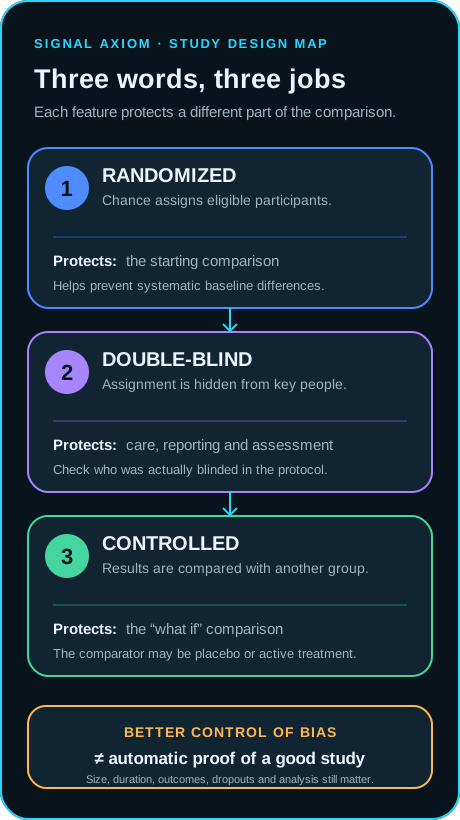
Three-card study design map. Randomization protects the starting comparison. Double blinding protects care, reporting and assessment. A control group protects the what-if comparison. A final note says better control of bias does not automatically prove a study is good.
2026-10-05

A mouse dose is not a human protocol

Animal research can guide the next experiment. It cannot tell a person what amount, route or schedule to use.
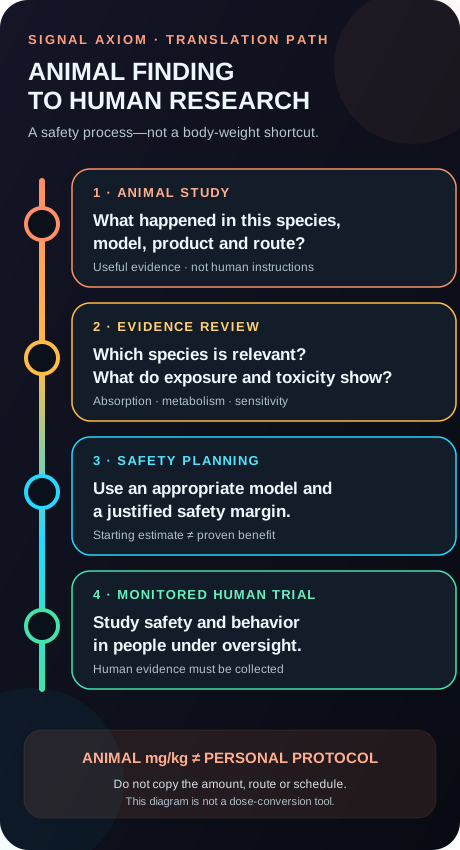
Four-step animal-to-human research map. An animal study is reviewed for relevant species, exposure, toxicity, metabolism and sensitivity. Safety planning applies an appropriate model and safety margin. A monitored human trial then collects human evidence. A warning states that animal milligrams per kilogram are not a personal protocol.
2026-10-04

A number without its unit is incomplete

10 mg, 10 mL, 10 syringe markings and 10 IU answer different questions. Learn what each number means before using a calculator.

SIGNAL AXIOM · VISUAL GUIDE
The same 0.10 mL can contain different amounts

Arithmetic example: 10 markings on a confirmed U-100 syringe equal 0.10 mL. The concentration determines the mass.

2.5 mg/mL concentration0.25 mg
5 mg/mL concentration0.5 mg
10 mg/mL concentration1 mg
2026-10-03

A biomarker changed. Did people actually benefit?

Biomarker, surrogate endpoint and clinical outcome are not interchangeable. Use this three-step check before calling a peptide result a benefit.
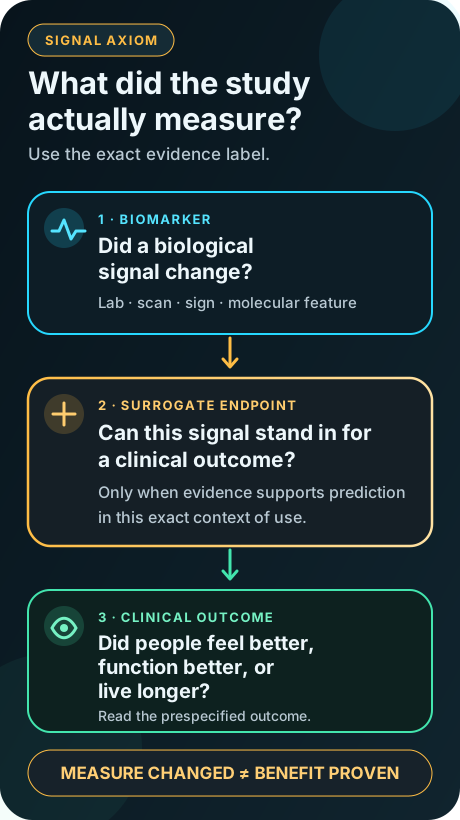
A three-card evidence translator. Biomarker asks whether a biological signal changed. Surrogate endpoint asks whether evidence supports using that signal in place of a clinical outcome for this exact context. Clinical outcome asks whether people felt better, functioned better, or lived longer. A warning says that a measurement changing does not by itself prove benefit.
2026-10-02

Phase 1 means first human questions—not proven benefit

A trial phase tells you which question researchers are ready to ask. It does not tell you that an experimental peptide works.
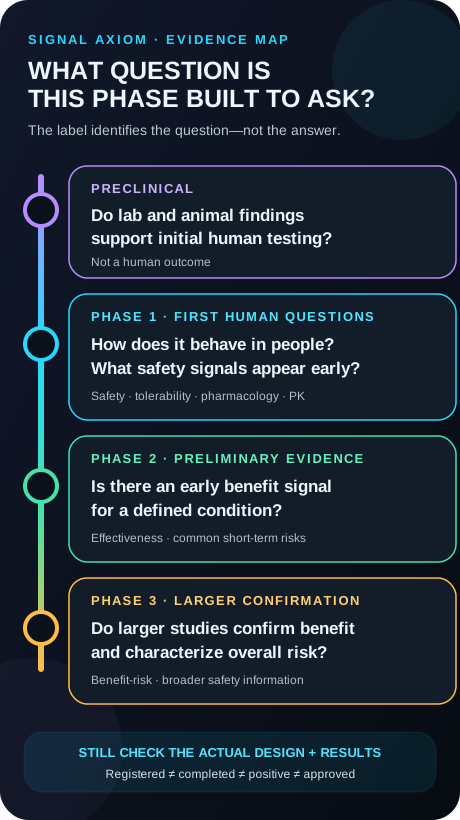
A four-stage clinical-research map. Preclinical asks whether laboratory and animal findings support initial human testing. Phase 1 asks how the product behaves in people and what short-term safety signals appear. Phase 2 asks whether there is preliminary evidence of benefit for a defined condition and what common short-term risks occur. Phase 3 asks whether larger studies confirm benefit and characterize the overall benefit-risk relationship. A note says that a phase label identifies the question, not the answer.
2026-10-01

“99% purity” does not answer four other questions

Purity, identity, content, impurity profile and microbiological quality are separate checks. One percentage cannot replace the rest.
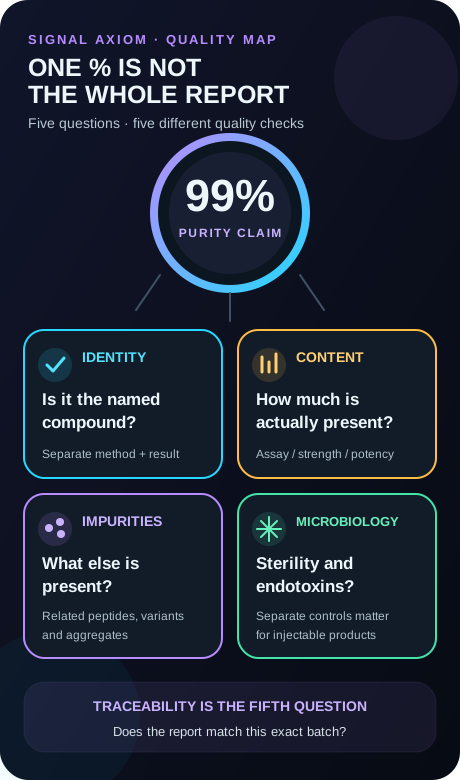
A 99 percent purity claim in the center surrounded by four separate quality questions: identity asks whether it is the named compound, content asks how much is present, impurity profile asks what else is present including related peptides or aggregates, and microbiology asks about sterility and endotoxins for injectable products. A final note says the report must match the exact batch.
2026-09-30

The fridge is not a universal peptide rule

Three official labels use three different after-mixing timelines. The exact product, formulation and container decide—not a generic peptide rule.
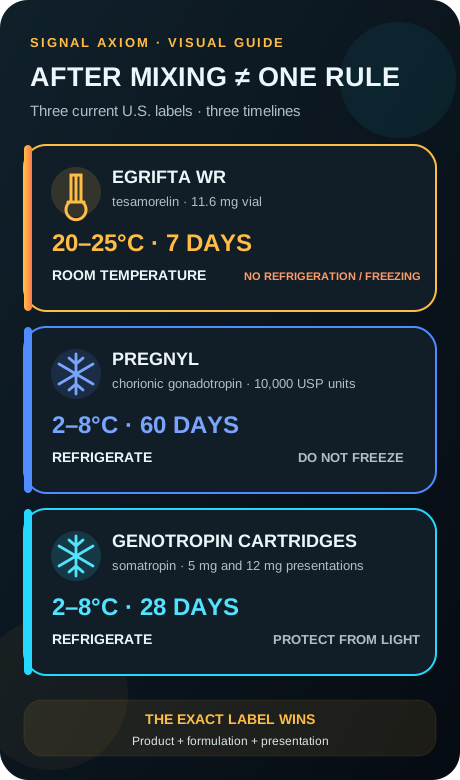
Comparison of official after-mixing storage instructions for three different prescription products. EGRIFTA WR is stored at 20 to 25 degrees Celsius and discarded after 7 days, with no refrigeration or freezing. PREGNYL is refrigerated at 2 to 8 degrees Celsius and discarded after 60 days. GENOTROPIN 5 and 12 milligram cartridges are refrigerated at 2 to 8 degrees Celsius and discarded after 28 days.
2026-09-29

Same concentration math. Different water rules.

Bacteriostatic Water and Sterile Water can produce the same arithmetic, but their ingredients, container use and discard instructions are different.
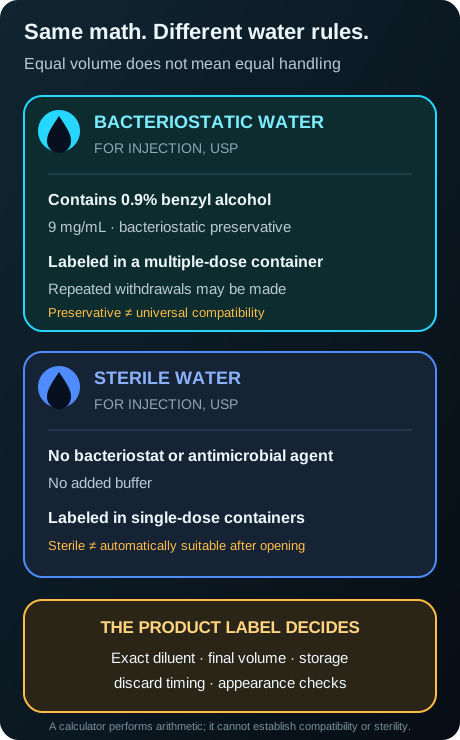
Comparison of Bacteriostatic Water for Injection and Sterile Water for Injection. Bacteriostatic Water contains 0.9 percent benzyl alcohol and is labeled in a multiple-dose container. Sterile Water has no bacteriostat, antimicrobial agent or added buffer and is labeled in single-dose containers. The exact product label decides the compatible diluent, storage and discard instructions.
2026-09-28

A community story is a signal, not proof

Personal experiences can raise useful questions. Structure, denominators and comparisons determine what those stories can support.
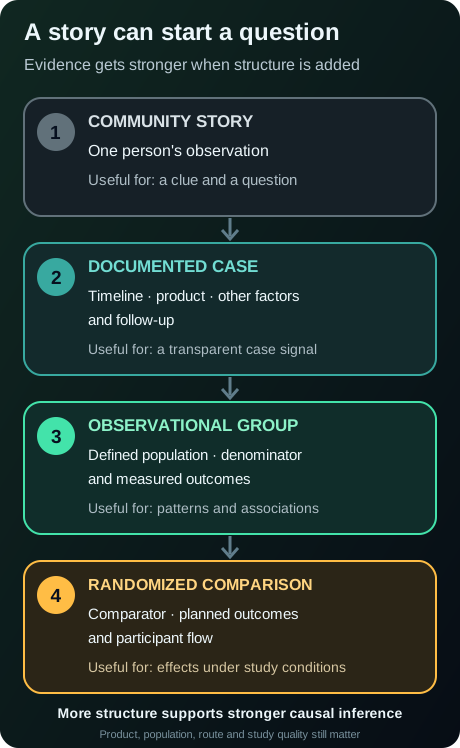
Four levels showing how evidence gains structure. A community story records one person's observation. A documented case adds a timeline, product details and follow-up. An observational group adds a defined population, denominator and measured outcomes. A randomized comparison adds a comparator, predefined outcomes and participant flow.
2026-09-27

IU on the vial are not U-100 syringe markings

The same word—unit—can describe potency or a syringe scale. Concentration is the bridge between them.
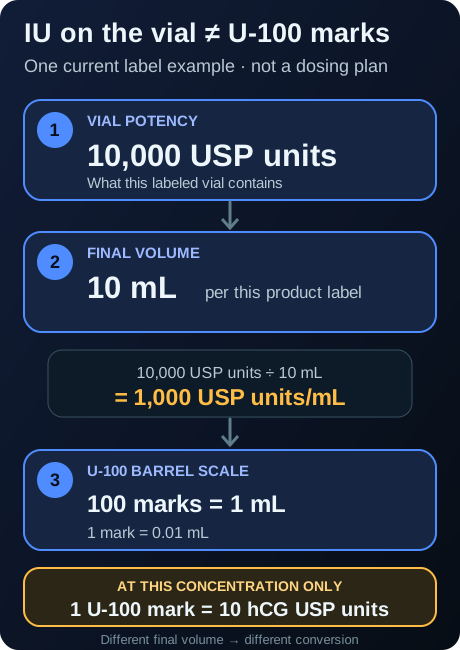
Three-step hCG measurement example. A current labeled product contains 10,000 USP units per vial and uses a 10 milliliter final volume, producing 1,000 USP units per milliliter. A U-100 syringe has 100 markings per milliliter, so one marking equals 0.01 milliliter and, for this product example only, 10 hCG USP units.
2026-09-26

A withdrawal trial is not a willpower test

SURMOUNT-4 changed treatment after week 36. The two paths explain maintenance, not personal failure.
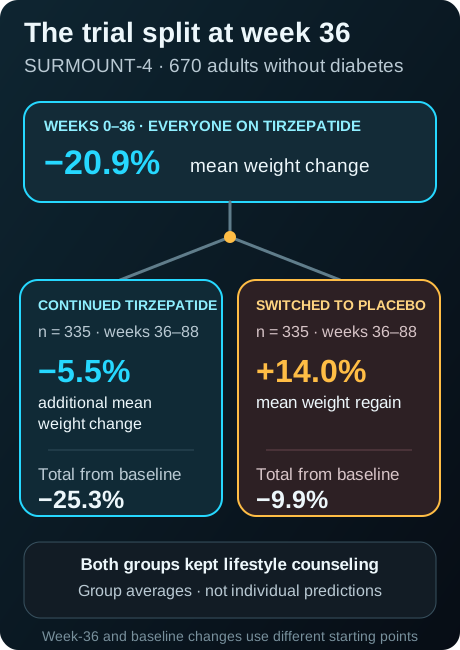
SURMOUNT-4 trial timeline. After 36 weeks of tirzepatide, 670 adults without diabetes had lost 20.9% of body weight on average. From week 36 to 88, 335 continued tirzepatide and lost another 5.5%, while 335 switched to placebo and regained 14.0%. Overall change from baseline was a 25.3% reduction and a 9.9% reduction, respectively.
2026-09-25

1,039 BPC-157 users still do not equal a clinical trial

A new records study shows BPC-157 use is rising. Here is what those notes can reveal, and what they cannot prove.
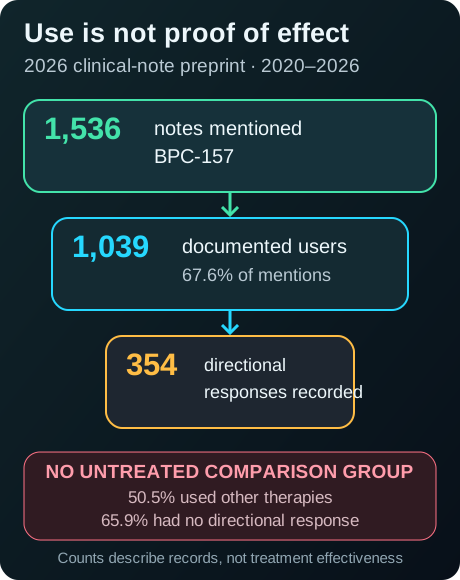
Funnel diagram of a 2026 BPC-157 preprint: 1,536 clinical notes mentioned BPC-157, 1,039 people had documented use, and 354 had a directional response recorded. The study had no untreated comparison group, half used other therapies, and 65.9% had no directional response documented.
2026-09-24

Half-life is not a dosing schedule

Half gone is not all gone. A visual guide to what a peptide's half-life tells you, and what it cannot decide.
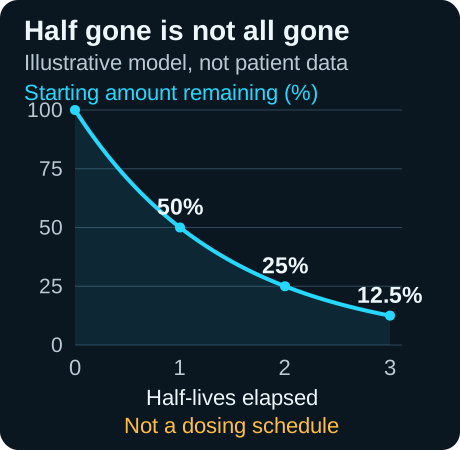
Illustrative first-order elimination curve, not patient data: 100% at the starting point, 50% after one half-life, 25% after two, and 12.5% after three. Time is measured in half-lives, not hours or days.
2026-09-23

Cagrilintide is not another GLP-1: read the combination trial correctly

A 2026 phase 3 trial tested a specific cagrilintide and semaglutide combination. That result does not validate every vial sold with both names.

SIGNAL AXIOM · VISUAL GUIDE
Weight change at 68 weeks

REDEFINE 5 · Estimated average weight reduction

Cagrilintide + semaglutide18.4%
Semaglutide alone11.9%
2026-09-22

MOTS-c and exercise: what the human study actually measured

Measuring a peptide after exercise is not the same as testing a peptide injection. Here is how to tell the evidence apart.

2026-09-21

Same molecule, different product: the route changes the evidence

Oral and injected peptide products are not interchangeable just because the active molecule has the same name.

2026-09-20

Retatrutide headlines: TRIUMPH-1 now has a full paper

The September 29 phase 3 publication replaces the topline-only evidence for TRIUMPH-1, while other program results remain sponsor-reported.

2026-09-19

Your vial. Your concentration. A clear units result.

A quick guide to custom vial amounts, mg and mcg, and the U-100 scale in Signal Axiom.

2026-09-19

Weight loss is more than a number on the scale

Read body-composition headlines carefully, and bring better questions to your next appointment.

2026-09-19

Same amount. Different vial. Different volume.

Understand mg, mcg and mL in one minute.

2026-09-19

GLOW and KLOW: see every ingredient

A blend’s total is not the amount of each peptide.

2026-09-19

DSIP: check the route, not just the name

An online schedule and a clinical study answer different questions.

2026-09-19

Tesamorelin: the formulation matters

A familiar molecule does not make every vial interchangeable.

2026-09-19

Read a protocol without getting lost

Five details to check before comparing two schedules.