

A few words, made simple
- Surrogate endpoint
- A measurement used in place of a health outcome. It needs evidence that it predicts that outcome in the specific setting.
- Clinical outcome
- A result about how people feel, function or survive.
- Biomarker
- A measured sign in the body. A change does not by itself prove someone feels or functions better.
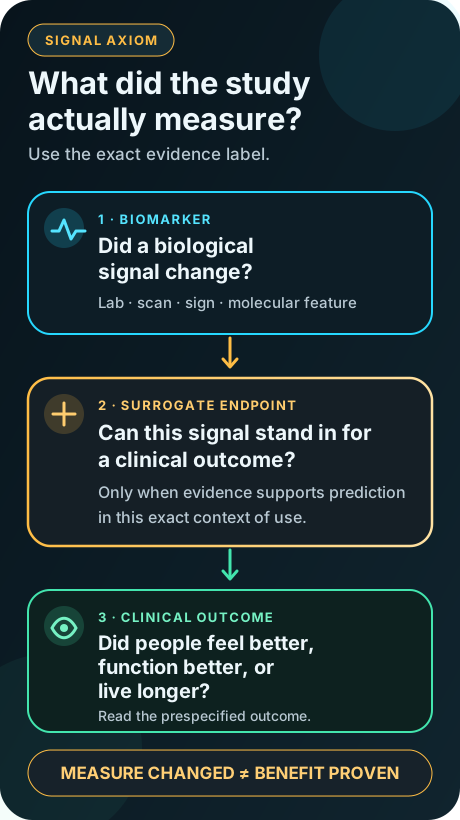
A useful measurement is not automatically a health benefit
A biomarker is a defined characteristic measured as an indicator of a biological process, disease process, or response to an exposure or intervention. Biomarkers can help select participants, monitor safety, or show that a product affected the body. [1,2] Those jobs matter, but a changed laboratory value, scan, physical sign or molecular signal does not by itself show that a person feels better, functions better or lives longer.
Clinical outcomes answer the patient-important question
FDA describes clinical outcomes as direct measures of whether people feel or function better, or live longer. [1,2] Depending on the study, that might mean symptoms, physical performance, hospitalization, a disease event, survival or another prespecified outcome. Read the exact endpoint and how it was measured. A study can collect biomarkers and clinical outcomes at the same time, but they are not the same result.
A surrogate endpoint is a special role, not a synonym for biomarker
Some biomarkers can serve as surrogate endpoints: substitutes expected to predict a clinical benefit that is not measured directly. FDA says accepting a surrogate in place of a clinical outcome requires evidence, often from epidemiology and clinical trials, and the strength of support ranges from candidate to reasonably likely to validated. [2] Most biomarkers are not automatically surrogates, and a surrogate does not directly measure the clinical benefit of primary interest.
Context is part of the claim
A surrogate endpoint may be acceptable for one disease, population, mechanism, treatment setting or development program and not another. FDA's current surrogate-endpoint table says acceptability is decided case by case and should not be assumed across different clinical settings. [3] So “this marker predicts benefit” is incomplete. Ask: for which condition, people, product, mechanism, route, duration and intended outcome?
Why this matters when reading peptide claims
A peptide may change a molecular signal in cells, an animal biomarker, human pharmacokinetics, or a laboratory value in a small clinical study. Each finding can answer a real research question, but none should be silently upgraded into a patient benefit. Laboratory and animal evidence must remain labeled as such. Human biomarker findings still need the studied product, route, population, comparator, duration and clinical meaning stated plainly.
The six-line outcome check
Write down: (1) the exact product and route; (2) humans, animals or laboratory model; (3) the measurement that changed; (4) whether it was prespecified; (5) whether it is an accepted surrogate for this exact context; and (6) whether symptoms, function, events or survival were measured. Then check duration, missing data, adverse events and dropouts. If only a biomarker changed, say only that.
Evidence boundary
This guide teaches evidence vocabulary. It does not determine whether a particular biomarker is valid, approve a peptide product, interpret personal laboratory results, recommend treatment or create a dosing protocol. Even validated surrogate endpoints can miss effects relevant to overall benefit and risk. [1] Questions about an individual test or therapy belong with a licensed clinician who can interpret the full clinical context.
Publication and source check
This article and graphic were first published October 3, 2026. Sources checked October 3, 2026. Current FDA definitions and the FDA–NIH BEST resource were checked directly. PeptideDosages.com was used only as an editorial topic and usability reference; its wording, graphics, protocol tables and dosing content were not copied.
Sources
- [1] FDA: FDA Facts—Biomarkers and Surrogate Endpoints / datos sobre biomarcadores y desenlaces sustitutos. Checked / revisada: 2026-10-03.
- [2] FDA: Surrogate Endpoint Resources for Drug and Biologic Development / recursos sobre desenlaces sustitutos. Checked / revisada: 2026-10-03.
- [3] FDA: Table of Surrogate Endpoints—context and limitations / tabla de desenlaces sustitutos, contexto y limitaciones. Content current 2026-04-29; checked / revisada: 2026-10-03.
- [4] FDA–NIH Biomarker Working Group: BEST Resource / recurso BEST. Originally published / publicación original: 2016; checked / revisada: 2026-10-03.
- [5] PeptideDosages.com: BPC-157 10 mg protocol page—editorial usability reference only / solo referencia editorial de usabilidad. Checked / revisada: 2026-10-03.