

A few words, made simple
- Effect estimate
- The measured difference or relationship reported by a study, such as the difference between treatment and control groups.
- P-value
- Under a specified statistical model, a measure of how incompatible the observed data are with the tested null hypothesis. It is not the probability that a treatment works.
- Confidence interval
- A range calculated from the data to show the uncertainty around an estimate under the analysis method used.
- Clinical relevance
- Whether the size and kind of change are important in the real health context, considering the outcome, timeframe, benefits, harms and population.
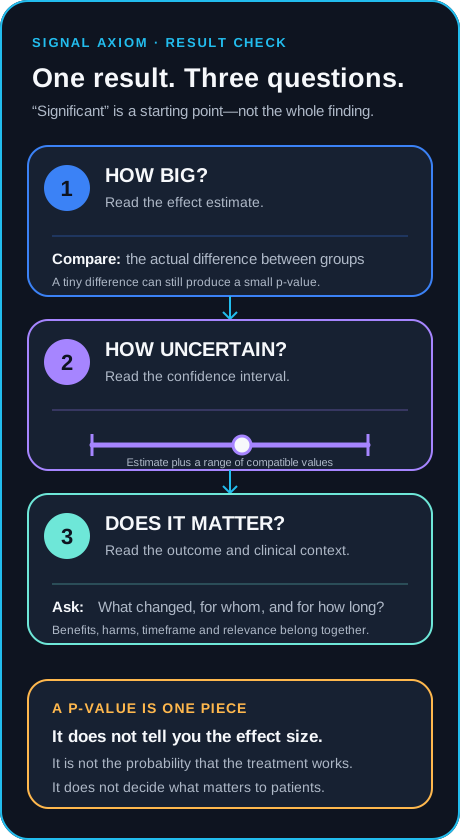
The plain-language takeaway
“Statistically significant” does not mean large, important, certain, safe or proven for every person. It means a statistical test crossed a prespecified threshold under its assumptions. To understand the result, also read the effect estimate, confidence interval, measured outcome, timeframe, participant population, harms and study design. ICH E9 says confirmatory trials should estimate the size of an effect with due precision and relate it to clinical significance—not stop at a hypothesis test. [1]
What a p-value can—and cannot—say
A p-value is calculated under a statistical model and a tested null hypothesis, often a model of no difference between groups. A small p-value says the observed data would be relatively incompatible with that model if its assumptions hold. It does not report the size of the difference. It is not the chance that the result happened “by accident,” the probability that the treatment works, or the percentage of participants who benefited. Those are different questions.
Effect size answers the “how much?” question
The effect estimate describes what the study measured: perhaps an average difference, a change in the proportion of participants with an outcome, or a ratio between event rates. Read the result for each group and the between-group estimate in the original unit. A large study can make a very small difference statistically detectable. That difference may still be too small to matter—or it may matter greatly—depending on the outcome and context.
The confidence interval shows precision
A confidence interval places a range around the estimate using the study's data and analysis method. ICH E9 recommends reporting treatment-effect estimates with confidence intervals whenever possible. [1] A wide interval means the study leaves a broader set of effect sizes compatible with the data; a narrow interval is more precise. The interval does not repair bias, missing data, selective reporting or a poorly chosen outcome, so precision and study quality must be read together.
Meaning depends on what was measured
Next ask whether the outcome is important to participants. A change in a laboratory value, body measurement, rating scale, symptom, hospitalization or survival does not carry the same meaning. The relevant amount of change is not universal across outcomes or populations. Review the timeframe, baseline severity, known benefits, harms, dropouts and whether the exact product, formulation and route match the claim. Statistical significance cannot make a surrogate marker equal a proven health benefit.
More tests create more chances for a false win
If researchers test many outcomes, timepoints, subgroups or analyses, at least one small p-value can appear even when no real effect exists. FDA's multiple-endpoints guidance explains why trials prespecify primary questions and control multiplicity. [3] Check whether the highlighted result was the registered primary outcome, whether the analysis was planned before the data were seen, and whether statistical adjustments were used when needed. An interesting exploratory result can guide another study; it is not automatically confirmatory proof.
A four-line way to read a result
Write down: (1) what outcome was measured and when; (2) the result in each group; (3) the between-group effect estimate with its confidence interval; and (4) the main harms, missing data and dropouts. Then add the p-value only as part of the planned statistical analysis. CONSORT 2025 asks trial reports to provide enough design, analysis, interpretation and participant-flow information for readers to appraise the evidence—not just a significance label. [2]
Practical recap and what remains unknown
Treat “statistically significant” as a prompt to keep reading. Ask how big, how uncertain and how meaningful. Even a well-reported result may not establish long-term safety, individual response, effects in unstudied populations or equivalence to a differently made research vial. This article teaches result-reading; it does not validate a peptide, create a protocol or predict what will happen to one person.
Publication and source check
This article and graphic were first published October 8, 2026. Sources checked October 8, 2026. ICH statistical guidance, CONSORT 2025 and FDA multiple-endpoints guidance were reviewed directly. PeptideDosages.com was reviewed only as an editorial usability reference for how study claims and practical peptide information are presented together; its wording, tables, graphics and schedules were not copied.
Quick check: A headline says a peptide result was statistically significant. What three questions should you ask next?
Ask how large the effect was, how uncertain the estimate is, and whether the measured outcome matters in the clinical context. Then check the timeframe, harms, population, product, route and whether the highlighted analysis was prespecified.
Sources
- [1] ICH E9: Statistical Principles for Clinical Trials. Published / publicada: 1998-02-05; checked / revisada: 2026-10-08.
- [2] CONSORT 2025 Statement: updated guideline for reporting randomized trials. Published / publicada: 2025; checked / revisada: 2026-10-08.
- [3] FDA: Multiple Endpoints in Clinical Trials Guidance for Industry. Published / publicada: 2022-10; checked / revisada: 2026-10-08.
- [4] PeptideDosages.com dosage directory—editorial usability reference only / solo referencia editorial de usabilidad. Checked / revisada: 2026-10-08.