

A few words, made simple
- Randomized
- People are assigned to study groups by chance.
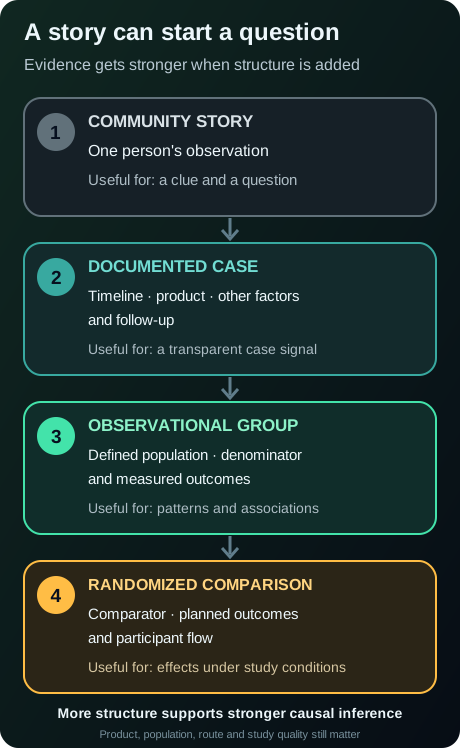
A story answers one narrow question
A community post can honestly answer, “What did this person notice?” It usually cannot answer why the change happened, how often it happens or whether the same result would occur in someone else. Symptoms can change with time, expectations, other treatments, sleep, diet, training, illness or the natural course of a condition. A sincere report can still be wrong about cause.
The missing denominator changes everything
Seeing 20 positive stories does not reveal whether 25, 250 or 25,000 people used the product. It also misses people who never posted, stopped early or had no noticeable result. FDA makes the same point about its much more formal adverse-event system: reports can identify possible signals, but they cannot establish causation or calculate occurrence rates because reporting is incomplete and duplicates can exist. [1]
Details make a story more useful—not causal
A more informative account names the exact product and formulation, route, timing, baseline problem, other treatments, objective measurements, adverse effects and follow-up. The CARE guideline for medical case reports formalized this idea with patient information, a timeline, clinical findings, interventions, outcomes and informed consent. Those details improve transparency; they do not create a control group or prove effectiveness. [2]
Repeated stories can generate a hypothesis
When similar reports repeat with the same product, timing and outcome, the pattern may justify closer monitoring or a formal study. That is signal generation: a reason to ask a better question, not permission to announce an answer. Unexpected or serious adverse events deserve clinical attention and can be reported through FDA MedWatch even when causation is uncertain. [1]
A randomized trial answers a different question
Randomization and a comparison group help separate a treatment effect from background change under defined study conditions. CONSORT 2025 asks trial reports to disclose 30 essential items plus participant flow so readers can judge what was planned, who entered, who completed and how outcomes were analyzed. A published trial can still be small, biased or poorly matched to a specific product; “randomized” is not a substitute for reading the methods. [3]
How Signal Axiom labels community experiences
Community experiences belong in their own clearly labeled section, separate from human trials, animal or laboratory findings, and official product labels. Signal Axiom uses them to show what people discuss and what questions recur—not to assign an effectiveness score, recommend a regimen or imply that an unverified vial matches a studied medicine. Read the linked source, date and context before treating any excerpt as useful.
Evidence boundary
This guide explains how to interpret reports; it does not claim that any peptide works or does not work. No animal or laboratory result is presented as a human outcome, and no community story is presented as a clinical protocol. Product identity, quality, sterility and concentration cannot be verified from a testimonial. Medical decisions require a licensed clinician and verified product information.
Publication and source check
This article and graphic were first published September 28, 2026. Sources checked September 28, 2026. FDA launched the current AEMS system and published its data limitations on March 11, 2026. The CARE guideline was published in 2013, and the updated CONSORT 2025 statement was published April 14, 2025.
Sources
- [1] FDA Adverse Event Monitoring System (AEMS): data limitations / limitaciones de los datos. Published / publicado: 2026-03-11.
- [2] Gagnier et al.: CARE case-report guideline / guía CARE para informes de casos. Published / publicado: 2013-11-05.
- [3] Hopewell et al.: CONSORT 2025 statement. Published / publicado: 2025-04-14.