

A few words, made simple
- Clinical outcome
- A result about how people feel, function or survive.
One word, two different measurements
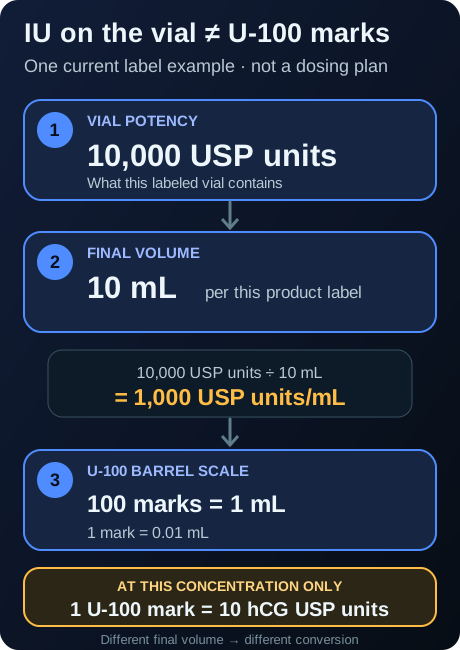
On an hCG vial, USP units describe the product's biological potency. On a U-100 insulin syringe, the numbered scale is tied to a liquid-volume system designed for insulin at 100 units per milliliter. Those numbers do not become hCG potency just because both labels use the word unit. A U-100 marking is best treated as a volume reference: 100 markings equal 1 mL, so one marking represents 0.01 mL. [2]
Concentration is the bridge
The conversion needs two facts from the exact finished product: total potency in the vial and final liquid volume. Divide vial potency by final volume to obtain potency per mL. Only then can a clinician-specified amount be converted to mL, and only then can mL be displayed on a compatible syringe scale. Skipping the concentration step is why copying the same number from a protocol to a syringe can produce a serious measurement error.
A worked label example—not a universal recipe
A current U.S. chorionic gonadotropin label lists 10,000 USP units per vial and directs adding 10 mL of its supplied diluent. That produces 1,000 USP units/mL. Because one U-100 marking represents 0.01 mL, one marking would contain 10 hCG USP units in this specific labeled example. This math does not select an amount to administer, change the labeled intramuscular route or apply automatically to a 5,000-unit vial, a compounded product or a research-labeled vial. [1]
Why another vial can produce another answer
Vial potency, final volume and syringe scale are separate variables. Changing any one of them changes the conversion. Even products with the same ingredient name can have different strengths, supplied diluents, routes, storage instructions and approved uses. Verify the exact vial label and preparation instructions; do not borrow a water volume or syringe conversion from a different brand, online chart or prior vial. [1]
What the calculator can—and cannot—do
Signal Axiom can convert confirmed potency, final volume and an amount already determined for the situation into mL and a U-100 visual. It cannot identify an unknown concentration, verify an unlabeled vial, choose a dose, choose a diluent, select a route or establish that a product is appropriate. If the label or preparation record does not state the final volume, stop and confirm it with the dispensing pharmacy or licensed clinician before calculating.
Evidence boundary
This guide explains label arithmetic and device-scale language. It does not compare clinical outcomes, recommend hCG treatment or extend an approved product's findings to compounded or research products. No animal or laboratory result is presented as a human outcome. FDA also states that hCG is prescription-only and is not approved for weight loss. [3]
Publication and source check
This article and graphic were first published September 27, 2026. Sources checked September 27, 2026. The chorionic gonadotropin label was revised in February 2025, and the U-100 insulin label was revised in May 2025. This article is educational and does not provide a personal dosing or reconstitution protocol.
Sources
- [1] Fresenius Kabi: Chorionic Gonadotropin for Injection label / etiqueta. Revised / revisada: 2025-02.
- [2] Lantus U-100 prescribing information / información de prescripción. Revised / revisada: 2025-05.
- [3] FDA: Avoid Dangerous HCG Diet Products / Evite productos peligrosos de dieta con HCG. Checked / revisado: 2026-09-27.