

A few words, made simple
- Eligibility criteria
- The requirements a person must meet—or must not have—to enter a study. They are often called inclusion and exclusion criteria.
- Study population
- The people actually enrolled and studied, not everyone who might later hear about the result.
- Generalizability
- A judgment about whether a result is likely to apply beyond the people, setting, product and conditions studied.
- Subgroup
- A smaller part of the study population, such as an age range or people with a particular condition.
The plain-language takeaway
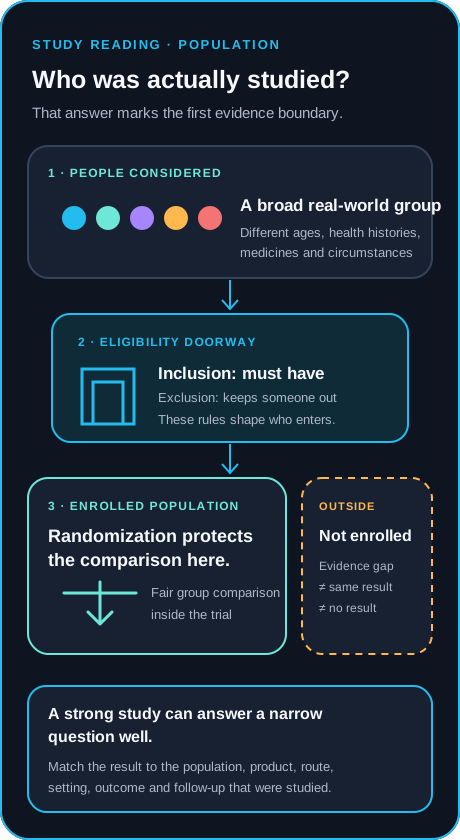
A study result belongs first to the people who were actually studied. Before extending it to someone else, compare age, health conditions, medicines, disease severity, setting, route, product and follow-up time. A difference does not automatically make the result useless. It marks a question that needs judgment—or more evidence.
The eligibility doorway
Researchers write inclusion criteria for traits participants must have and exclusion criteria for traits that keep someone out. These rules can protect participants, define the question and make measurements more interpretable. They also shape the study population. FDA defines eligibility criteria as the entry requirements for a trial and notes that they can include diagnosis, severity, age, sex, medical history, current health, physiology and other conditions. [2]
What randomization does—and does not do
Randomization assigns enrolled participants to study groups by chance. Its job is to protect the comparison inside the trial by reducing systematic differences between those groups. It does not rewind the earlier eligibility step or make the enrolled group a copy of every person who might use a product later. A trial can have strong internal validity—a fair comparison—and still have a narrow boundary.
Read the participant line before the headline
Look for a sentence that names the population: for example, adults within a stated age range, with a defined diagnosis and severity, taking or not taking specified medicines. Then look at the exclusion list. Were pregnancy, kidney or liver impairment, certain cardiovascular conditions, other medicines or previous treatments excluded? Those details help define what the result can—and cannot—directly answer.
A missing group is an evidence gap
If a group was not enrolled, the study usually cannot tell us that the treatment works the same, works differently or does not work in that group. It is simply not a direct answer. FDA's current guidance encourages broader participation because a wider range of baseline characteristics can better reflect the people likely to use an approved product and can help assess how those characteristics affect safety and effectiveness. [2]
Small subgroups need careful language
A paper may report results for a subgroup, but a small subgroup can produce an unstable estimate. Ask whether the subgroup question was planned before the data were seen, whether enough participants and events were available, and whether the comparison had a statistical interaction test. A promising subgroup pattern can guide future research without proving that the effect truly differs.
Human, animal and laboratory boundaries
Human evidence is strongest for the human population, product, route and outcome that were studied. A human trial in a narrow group does not automatically cover every other human group. Animal studies and laboratory experiments have an even earlier boundary: they can support biological plausibility, but they do not establish human benefit, human safety or a clinical protocol.
A five-line reading check
Write down: (1) who entered, (2) who was excluded, (3) where the study happened, (4) what exact product, route and comparison were used, and (5) how long participants were followed. CONSORT 2025 says eligibility, setting and intervention details are central to judging applicability and generalizability. [3] ICH E8(R1) likewise treats the study population, treatment, outcomes and context as critical parts of the question a study can answer. [1]
Practical recap and what remains unknown
Do not stop at “randomized.” Name the enrolled population and compare it with the person or group you are asking about. If important traits were excluded or scarcely represented, the size and direction of benefit, harms and longer-term outcomes may remain uncertain. That uncertainty is a reason for careful interpretation and qualified clinical guidance—not a reason to invent a dose or assume the answer.
Publication and source check
This article and graphic were first published October 12, 2026. Sources checked October 12, 2026. ICH E8(R1), FDA's December 2025 final guidance and the CONSORT 2025 reporting guideline were reviewed directly. PeptideDosages.com was reviewed only as an editorial usability reference for how a peptide evidence page keeps the studied population visible; its wording, tables, graphics and protocols were not copied.
Quick check: A randomized trial enrolled adults ages 18–64 and excluded pregnancy and severe kidney disease. Does randomization prove the same result for those excluded groups?
No. Randomization helps make the comparison fair among the people who entered the trial. It does not create direct evidence for people who were not enrolled. Evidence for those groups must come from appropriate data, not an assumption.
Sources
- [1] ICH E8(R1): General Considerations for Clinical Studies. Step 4 adopted / adoptada: 2021-10-06; checked / consultada: 2026-10-12.
- [2] FDA: Enhancing Participation in Clinical Trials—Eligibility Criteria, Enrollment Practices, and Trial Designs. Final guidance / guía final: 2025-12; checked / consultada: 2026-10-12.
- [3] Hopewell S et al. CONSORT 2025 explanation and elaboration. BMJ. Published / publicado: 2025-04-14; checked / consultado: 2026-10-12.
- [4] PeptideDosages.com ARA-290 page—editorial usability reference only / solo referencia editorial de usabilidad. Checked / consultada: 2026-10-12.