

A few words, made simple
- Clinical outcome
- A result about how people feel, function or survive.
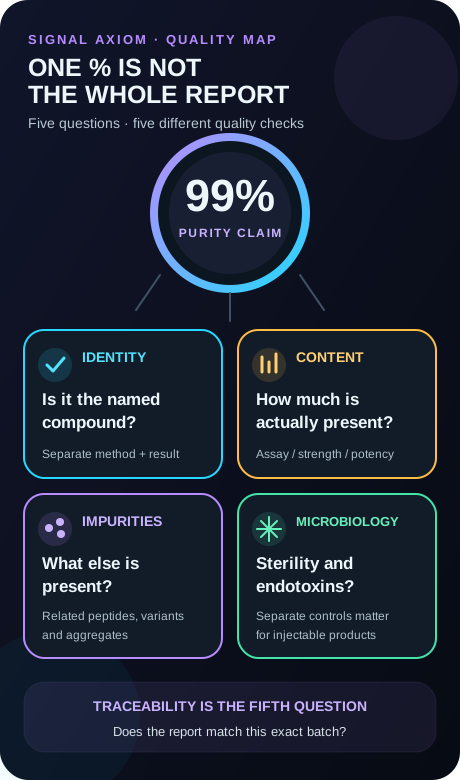
A purity percentage answers one narrow question
A result such as “99% purity” belongs to a particular sample, analytical method, acceptance rule and date. It does not automatically identify the compound, measure the total amount in a vial, prove sterility, rule out endotoxins or show that the tested sample came from the vial in your hand. FDA’s Q2(R2) guidance treats identification, assay, purity and impurity testing as distinct analytical purposes that require fit-for-purpose procedures. [1]
Question 1: Is it the named compound?
Identity testing asks whether the expected analyte is actually present. A chromatographic purity result can show how one method separated signals, but a high area percentage alone is not the same as a complete identity determination. Q2(R2) describes identification as obtaining a positive result comparable to reference material while also showing negative results for samples without the analyte. [1] Read the identity method and result separately from the purity number.
Question 2: How much is actually present?
Assay or content answers a different question: how much active material is in the sample relative to a reference or labeled claim. FDA’s analytical-method guidance lists identity, strength, quality, purity and potency as related but separate attributes to document. [2] A vial can show a high relative purity result yet still contain a different total amount than its label claims. The calculator can use a stated vial amount; it cannot verify that amount.
Question 3: Which impurities and aggregates are present?
“The other 1%” is not one interchangeable category. Peptide-related variants may closely resemble the intended sequence, and aggregates may require different characterization. FDA’s July 28, 2026 draft product-specific peptide guidances address impurity thresholds, higher-order structure, biological activity and innate immune response testing—not purity percentage alone. [3] FDA also warns that aggregation and peptide-related impurities can contribute to immunogenicity concerns for certain compounded peptides. [6]
Question 4: What about sterility and endotoxins?
Chemical purity does not answer microbiological questions. FDA’s current IND chemistry, manufacturing and controls page lists sterility, pyrogenicity, endotoxin levels and particulate matter separately for injectable products. Its March 2026 endotoxin guidance recommends testing appropriate components and finished products for pyrogens and endotoxins using validated approaches. [4,5] A clear solution and a high purity number cannot substitute for those controls.
The report must match the exact batch
A useful report identifies the testing laboratory, sample or lot number, dates, methods, specifications and actual results. Those details help establish traceability; they still do not prove that every vial sold under the same product name was sampled, manufactured or stored the same way. A screenshot without a verifiable report, or a report whose lot number does not match the container, cannot establish the quality of that container.
A six-line COA reading check
Check that the product and exact lot match; the laboratory and report are independently verifiable; the identity method and result are shown; assay or content is reported separately; purity and named impurities include methods and limits; and injectable-product microbiology is addressed with relevant sterility and endotoxin results. Missing information is not automatically a failed result, but it remains an unanswered question. Do not turn a partial report into a medical clearance.
Evidence boundary
This guide explains what common quality terms can and cannot support. It does not authenticate a certificate, approve a seller, verify a specific vial, establish sterility or recommend use. No laboratory result is presented as a human clinical outcome, and no dosing protocol is provided. A licensed pharmacist, clinician or qualified analytical professional is needed for product-specific interpretation.
Publication and source check
This article and graphic were first published October 1, 2026. Sources checked October 1, 2026. FDA issued Q2(R2) in March 2024, its analytical-method guidance in July 2015, revised draft peptide product-specific guidances on July 28, 2026, and revised pyrogen and endotoxin testing guidance in March 2026. PeptideDosages.com’s glossary was used only as an editorial usability reference; the scientific and regulatory claims above were checked against FDA sources.
Sources
- [1] FDA / ICH Q2(R2): Validation of Analytical Procedures. Issued / emitida: 2024-03.
- [2] FDA: Analytical Procedures and Methods Validation for Drugs and Biologics. Issued / emitida: 2015-07.
- [3] FDA: Revised draft product-specific guidances for peptide products. Published / publicado: 2026-07-28.
- [4] FDA: Pyrogen and Endotoxins Testing Q&A. Revised / revisada: 2026-03.
- [5] FDA: IND chemistry, manufacturing and controls information / información de química, fabricación y controles para IND. Checked / revisada: 2026-10-01.
- [6] FDA: Bulk substances that may present significant safety risks / sustancias a granel con posibles riesgos importantes. Checked / revisada: 2026-10-01.