

A few words, made simple
- Adverse event
- An unfavorable medical occurrence after a product is given. It does not automatically mean the product caused it.
- Adverse reaction
- An unwanted response for which a causal relationship with the product is considered at least reasonably possible.
- Exposure
- How many participants received the product, at what amount and for how long.
- Safety signal
- Information suggesting a possible new or changed risk that needs further evaluation; it is not the same as confirmed causation.
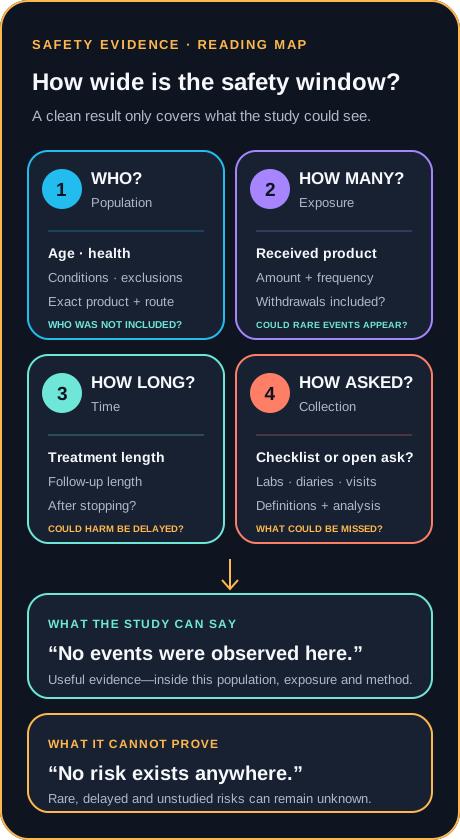
The plain-language takeaway
If a study says no adverse events were reported, the accurate conclusion is narrow: none were recorded under that study's methods, participants and timeframe. It does not prove that the product has no risks. Small or short studies can miss rare, delayed or population-specific harms, and incomplete collection or reporting can hide events that occurred. Safety is built from the full body of evidence, not one reassuring sentence.
First, separate an event from a reaction
ICH E2A defines an adverse event as an unfavorable medical occurrence after a pharmaceutical product is given, whether or not the product caused it. An adverse reaction adds a causal judgment: a relationship to the product is at least reasonably possible. [1] This distinction prevents two opposite mistakes—assuming every event was caused by the product, or ignoring an event because causation was not yet proven.
Ask how many people were actually exposed
The chance of observing an uncommon problem grows as more people are studied. ICH E1 explains that clinical development is not expected to characterize very rare events and that the size of the safety database must be considered alongside the expected frequency of events. [2] A zero in a small study can therefore be compatible with a risk that the study was simply too small to reveal. Read the number who received the exact product—not only the total number enrolled.
Time changes what a study can see
A brief exposure period mainly informs what happened during that brief period. Some harms may appear after repeated exposure, after stopping, or only with longer follow-up. ICH E1 treats duration of exposure and the timing of events as core parts of a safety database. [2] Check treatment length, follow-up length and whether participants who stopped early were still followed for harms.
Collection methods matter
“No events reported” can mean different things. Researchers may ask open-ended questions, use a structured checklist, review laboratory results, collect participant diaries or depend on spontaneous reports. CONSORT Harms 2022 calls for clear reporting of which harms were assessed, how they were defined, when they were collected, who collected them and how results were analyzed. [3] Without those details, a clean-looking sentence is hard to interpret.
Who was studied sets the boundary
A trial in healthy adults does not automatically establish safety in older adults, adolescents, pregnant people or people with kidney, liver or cardiovascular disease. Exclusion criteria may remove people most likely to experience a problem. Also check the exact formulation, manufacturing quality, route and combination used. Evidence for one regulated product cannot establish the safety of an unverified research vial or a blend with different ingredients.
Post-market reports answer a different question
After products are used more widely, spontaneous reports can help reveal possible safety signals that trials were not able to detect. But a report alone does not prove the product caused the event, and a report database cannot by itself calculate how often an event occurs. FDA lists duplicate, incomplete and unverified reports among the limitations of its Adverse Event Monitoring System. [4] Trial data and post-market reports are complementary, not interchangeable.
Practical recap and what remains unknown
When you read a safety claim, write down five things: the exact product and route, who was studied, how many received it, how long exposure and follow-up lasted, and how harms were collected. Then check the comparison group, withdrawals and serious events. A study with no recorded events can still be useful evidence; it simply does not close every safety question. For many research peptides and blends, long-term human safety, uncommon risks, interaction risks and product quality remain unknown.
Publication and source check
This article and graphic were first published October 9, 2026. Sources checked October 9, 2026. ICH E2A and E1, the CONSORT Harms 2022 publication and FDA's AEMS limitations were reviewed directly. PeptideDosages.com was reviewed only as an editorial usability reference for how safety context appears beside peptide information; its wording, tables, graphics and protocols were not copied.
Quick check: A 20-person, two-week study reports no adverse events. Does that prove the product is safe for long-term use?
No. It describes what was recorded in those 20 people during that short study under its collection methods. It may not detect uncommon, delayed or population-specific harms, and it does not establish long-term safety or safety for a different product, route or population.
Sources
- [1] ICH E2A: Clinical Safety Data Management—Definitions and Standards for Expedited Reporting. Step 4 dated / versión Step 4: 1994-10-27; checked / revisada: 2026-10-09.
- [2] ICH E1: The Extent of Population Exposure to Assess Clinical Safety. Step 4 dated / versión Step 4: 1994-10-27; checked / revisada: 2026-10-09.
- [3] CONSORT Harms 2022 statement, explanation and elaboration. Published online / publicación electrónica: 2023-04-24; checked / revisada: 2026-10-09.
- [4] FDA: Adverse Event Monitoring System (AEMS) Public Dashboard—data limitations. Checked / revisada: 2026-10-09.
- [5] PeptideDosages.com dosage directory—editorial usability reference only / solo referencia editorial de usabilidad. Checked / revisada: 2026-10-09.