

A few words, made simple
- Preclinical
- Laboratory and animal research performed before a proposed product is tested in people.
- NOAEL
- The no observed adverse effect level: the highest tested level at which a study found no significant treatment-related harmful effect. It is an animal-study result, not a human recommendation.
- Human-equivalent dose (HED)
- A modeled human estimate derived from animal information for research planning. It does not establish an effective or appropriate personal dose.
- Safety factor
- An additional reduction used to account for uncertainty before initial human exposure.
- First-in-human trial
- A monitored clinical study that evaluates a product in people for the first time.
The plain-language takeaway
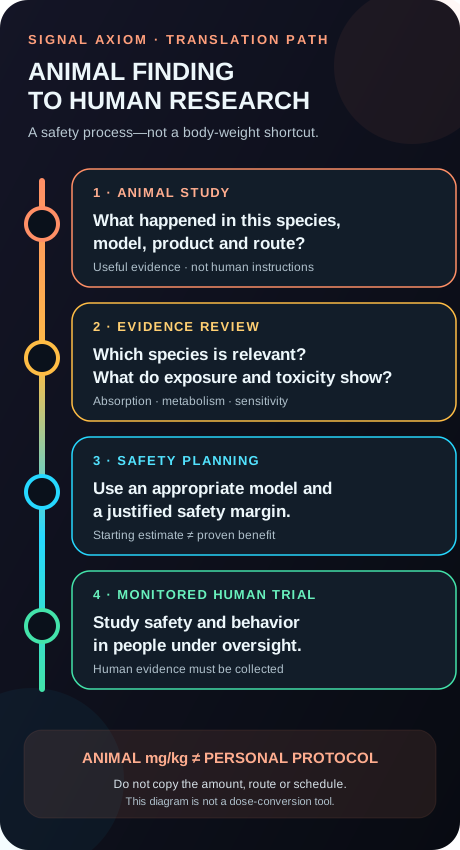
An amount used in a mouse, rat or another animal is evidence about that specific experiment. It is not a human instruction. The species, disease model, product, route, schedule and measured outcome all belong to the result. Copying only the mg/kg number strips away the information needed to interpret it and cannot create a personal protocol.
Body weight is only one variable
Species can absorb, distribute, metabolize and eliminate the same substance differently. They may also differ in receptor sensitivity, active metabolites and which toxicities an animal model can reveal. FDA's first-in-human guidance therefore calls for the full preclinical picture—not a direct body-weight ratio—including pharmacology, toxicology, bioavailability, metabolism and pharmacokinetics. [1] A simple multiplication cannot replace that review.
What a regulated translation process considers
For many initial trials in healthy adults, FDA describes a sequence that identifies an animal no observed adverse effect level (NOAEL), models a human-equivalent dose, selects the most relevant species information and applies a safety factor. [1] The exact method depends on the product and evidence. Some products, local toxicities and routes require a different approach. This is expert safety planning under research oversight—not a universal calculator for consumers.
A human-equivalent estimate is not a recommended dose
FDA's model helps researchers propose a maximum recommended starting dose for a monitored first-in-human study. The guidance explicitly focuses on the starting point, not later escalation or a maximum allowable dose. [1] That estimate does not prove effectiveness, identify a maintenance schedule, or show that unsupervised use is safe. Those are different questions that require human data.
Route, schedule and product stay attached
An oral experiment, an intravenous infusion, an injection under the skin and an injection into an animal's abdominal cavity are not interchangeable. Exposure can change with the route, formulation and timing. Product identity and purity also matter. If a study used one material and one route, its result does not validate a differently made vial, a different route or an online schedule with the same peptide name.
What animal evidence can and cannot establish
Animal studies can reveal biological signals, possible mechanisms and toxicities worth investigating. FDA explains that preclinical findings help researchers decide whether a product should move into human testing and provide information about toxicity. [2] They cannot by themselves establish human benefit, human long-term safety, a suitable amount for an individual, or whether a marketed research vial matches the study material.
Five questions to ask before repeating a claim
Ask: Which species and disease model were studied? What exact product or formulation was tested? Which route and schedule were used? Was the outcome a laboratory signal, a behavior or a health result? Has a controlled human trial tested the same claim? If the last answer is no, describe the finding as animal or laboratory evidence—promising, uncertain or negative as appropriate—not as a human protocol.
Practical recap and what remains unknown
Keep the animal result attached to its species, model, product, route, schedule and outcome. Do not convert an animal mg/kg amount into personal instructions. Even a professionally modeled human starting estimate remains a research-development tool, not proof of benefit. If there is no well-designed human evidence for the same product and use, human effectiveness, long-term risks and an appropriate clinical regimen remain unknown.
Publication and source check
This article and graphic were first published October 5, 2026. Sources checked October 5, 2026. FDA's July 2005 guidance and current preclinical-research overview were checked directly. PeptideDosages.com was reviewed only as an editorial usability reference for separating animal evidence from practical calculations; its wording, graphics, tables and schedules were not copied.
Quick check: A mouse study reports an effect at an amount in mg/kg. Can you multiply that number by a person's weight to create a human protocol?
No. Species biology, exposure, toxicity, relevant model, product, route and uncertainty must be evaluated, and human trials must collect human evidence. The animal amount alone does not establish a safe or effective personal amount, route or schedule.
Sources
- [1] FDA: Estimating the Maximum Safe Starting Dose in Initial Clinical Trials for Therapeutics in Adult Healthy Volunteers. Published / publicada: 2005-07; checked / revisada: 2026-10-05.
- [2] FDA: Step 2—Preclinical Research / Paso 2: investigación preclínica. Checked / revisada: 2026-10-05.
- [3] PeptideDosages.com: BPC-157 10 mg vial dosage protocol—editorial usability reference only / solo referencia editorial de usabilidad. Checked / revisada: 2026-10-05.