

A few words, made simple
- Trial registry
- A public database record that can describe a study's plan, status and submitted results.
- NCT number
- The unique identifier ClinicalTrials.gov assigns to a registered study, such as NCT followed by eight digits.
- Primary outcome
- The main measurement the study prespecifies, together with the time frame used to assess it.
- Peer review
- Evaluation of a journal manuscript by independent experts before publication. It is another quality checkpoint, not a guarantee that every conclusion is correct.
The plain-language takeaway
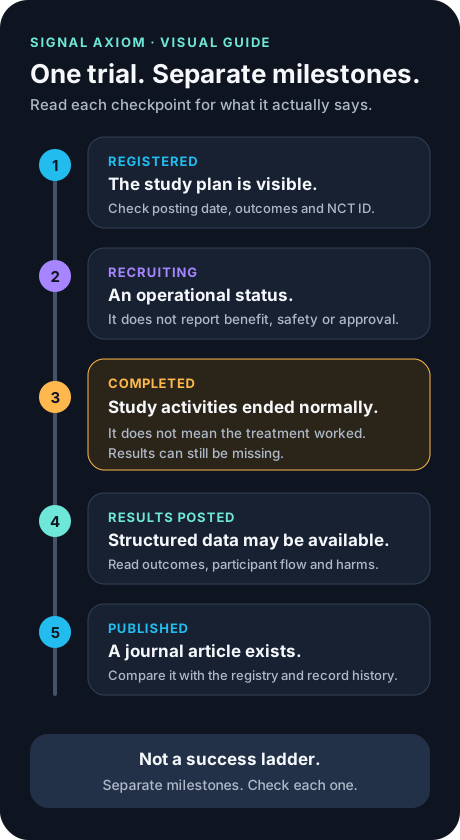
A registry record is not a result. “Recruiting,” “completed,” “results posted” and “published” answer different questions. Read each one separately before deciding what is known.
Registered means the study plan is visible
A ClinicalTrials.gov record can list the sponsor, population, study design, intervention, outcomes, time frames, enrollment and key dates. The NCT number makes that record traceable. Prospective registration—before the first participant is enrolled—also makes it easier to notice later changes or selective reporting. It does not show that the intervention is effective. [1,3]
Recruiting is an operational status, not proof
“Recruiting” means the study is seeking or accepting participants. Other statuses—such as not yet recruiting, active but not recruiting, suspended, terminated or withdrawn—also describe study operations. They do not report benefit. If a study stopped early, read the stated reason rather than guessing what happened.
Completed does not mean successful
On ClinicalTrials.gov, “completed” describes a study that ended normally and is no longer examining or treating participants. It does not mean the primary outcome was met, the treatment helped or the harms were acceptable. The registry keeps study status and result availability as separate fields—a completed record can still say “No Results Posted.” [1,2]
Results posted is a separate checkpoint
A posted results section can include participant flow, starting characteristics, outcome measurements and adverse events. That structured record may be useful even when no journal article exists. But submitting registry results is not the same as journal peer review, and the tables still need careful interpretation. Check the “Results First Posted” date and whether later updates changed the record. [1,2]
A published paper adds context—not perfection
A journal paper can add detailed methods, analyses, limitations and discussion, plus peer review. It should still be compared with the registry. Match the NCT number, primary outcome and time frame, planned enrollment, study dates and intervention. A difference may reflect a documented amendment or a selective reporting concern; the registry's record history helps you ask which. [3]
A five-click registry audit
Check: (1) the NCT number, (2) “First Posted” compared with “Study Start,” (3) the primary outcome and its time frame, (4) current status plus completion date, and (5) the Results tab, “Results First Posted,” linked publications and Record History. These checks separate the plan, the study's progress, the available data and the later interpretation.
Keep the evidence boundary visible
ClinicalTrials.gov includes human interventional and observational studies. A registered human trial without results shows a plan, not evidence of benefit or safety. A completed trial with no public results leaves the outcomes unknown. Animal and laboratory findings remain preclinical evidence even if a human study is planned or mentioned; they do not establish a human effect or a clinical protocol.
Practical recap and what remains unknown
A listing means a record exists. Completed means study activities ended. Results posted means structured data are available. Published means an article exists. None of those labels alone answers whether the exact product, route and population had a meaningful benefit with acceptable harms. Read the actual outcomes, comparison, follow-up and limitations—and do not turn a registry status into a dosing instruction.
Publication and source check
This article and graphic were first published October 13, 2026. Sources checked October 13, 2026. ClinicalTrials.gov Study Basics, policy and data-element definitions and the ICMJE recommendations updated in January 2026 were reviewed directly. PeptideDosages.com's BPC-157 page was reviewed only as an editorial usability reference for keeping study status and evidence limits visible; its wording, tables, graphics and protocols were not copied.
Quick check: A peptide trial is marked “Completed,” but its Results tab says “No Results Posted.” Can we say the peptide worked?
No. “Completed” describes the study's operational status. Without posted results or a reliable publication, its measured effects, harms and primary-outcome result remain unknown.
Sources
- [1] ClinicalTrials.gov: Study Basics—How to Read a Study Record and Study Results. Checked / consultada: 2026-10-13.
- [2] ClinicalTrials.gov: Policy and protocol/results data element definitions. Checked / consultada: 2026-10-13.
- [3] ICMJE: Clinical Trial Registration. Current recommendations updated / recomendaciones vigentes actualizadas: 2026-01; checked / consultada: 2026-10-13.
- [4] PeptideDosages.com BPC-157 page—editorial usability reference only / solo referencia editorial de usabilidad. Checked / consultada: 2026-10-13.