

A few words, made simple
- Mass
- How much material there is. A milligram (mg) is one-thousandth of a gram; a microgram (mcg) is one-thousandth of a milligram.
- Biological effect
- A change in the body caused by an interaction with a substance, such as a change in blood glucose.
- Potency
- How much of a substance is needed for a defined effect under specified conditions. It is not a general score for how useful or safe it is.
The plain-language takeaway
A bigger mg number is not a bigger benefit. Milligrams measure mass, not a universal unit of peptide activity. Before comparing amounts, name the exact substance and the effect you are asking about.
Read the label as an amount—not a ranking
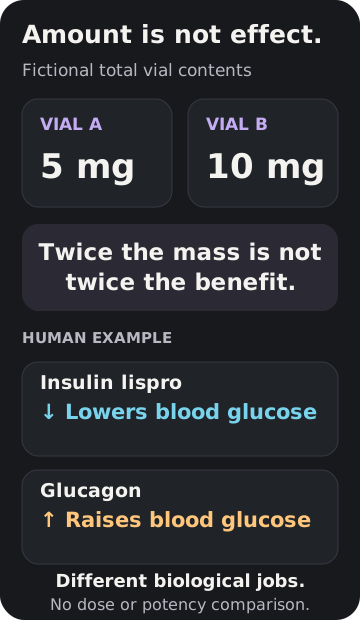
Imagine a fictional vial A labeled 5 mg and a different peptide's vial B labeled 10 mg. These numbers describe declared total vial contents: B contains twice the labeled mass, but that does not establish twice the activity, twice the benefit or greater potency. They are not amounts for one administration. This example teaches label reading, not a regimen.
Two peptide medicines, different jobs
The current HUMALOG label explains that insulin lispro lowers blood glucose by helping muscle and fat take up glucose and reducing glucose production by the liver. [1] The GVOKE label explains that glucagon activates glucagon receptors in the liver, promoting breakdown of stored glycogen—a stored form of glucose—and glucose release into the blood. Adequate liver glycogen is needed for its glucose-raising effect. [2] Both are peptide medicines. Their different jobs show why mass alone cannot describe biological action. This is not an equal-dose experiment, a reason to combine them or a guide to using either medicine.
Keep the measurement questions separate
Total vial contents are not the intended mass for one administration. Concentration in mg/mL describes mass per liquid volume; mL measures liquid volume. Syringe-scale markings depend on the specific syringe and are not generic mg. Biological international units (IU) describe activity for a specified substance and standard—not a universal conversion between peptides. None of these measurements is a cross-peptide benefit ranking. If a label or preparation detail is missing, verify it with a qualified pharmacist or prescriber; do not guess.
What the evidence can—and cannot—say
Human clinical evidence and prescription labeling support the specific insulin lispro and glucagon examples above. They do not validate another research peptide or blend. Laboratory activity and animal findings can help explain a possible action, but they cannot establish a human benefit, safe amount or clinical schedule. To compare different treatments, you need evidence for a defined outcome, population, product, route and time frame—not just their mg numbers.
Practical recap and what remains unknown
Use mg to answer “how much material?” Use appropriate clinical evidence to ask “what does this exact product do?” A vial's amount alone leaves effect size, benefit, harms and suitability unknown. A calculator can organize arithmetic; it cannot supply those missing biological answers.
Publication and source check
First published October 14, 2026; sources checked October 14, 2026. HUMALOG prescribing information revised January 2026 and GVOKE prescribing information revised September 2026 were reviewed directly. PeptideDosages.com's calculator was reviewed only as an editorial usability reference for separating mass and concentration fields; no text, tables, graphics or protocols were copied.
Quick check: Vial B lists 10 mg and a different peptide's vial A lists 5 mg. Does B have twice the benefit?
No. B lists twice the total mass, not twice the benefit. Different substances can have different biological actions. Their clinical effects cannot be inferred from vial amounts alone.
Sources
- [1] HUMALOG (insulin lispro): prescribing information, sections 12.1–12.3. Revised / revisada: 2026-01; DailyMed updated / actualizado: 2026-06-16; checked / consultada: 2026-10-14.
- [2] GVOKE (glucagon): prescribing information, sections 5.4 and 12.1–12.2. Revised / revisada: 2026-09; DailyMed updated / actualizado: 2026-10-06; checked / consultada: 2026-10-14.
- [3] PeptideDosages.com calculator—editorial usability reference only / solo referencia editorial de usabilidad. Checked / consultada: 2026-10-14.