

A few words, made simple
- Randomization
- Using chance to assign eligible participants to study groups.
- Blinding (masking)
- Keeping treatment assignment hidden from specified people so expectations are less likely to change care, reporting or assessment.
- Placebo
- A comparison made to resemble the test treatment but without the test drug. Participants may still receive other standard care.
- Control group
- The group used to estimate what might have happened without the test treatment. It may receive placebo, no treatment, a different regimen or an active treatment.
- Bias
- A systematic influence that can push a study's comparison away from the truth.
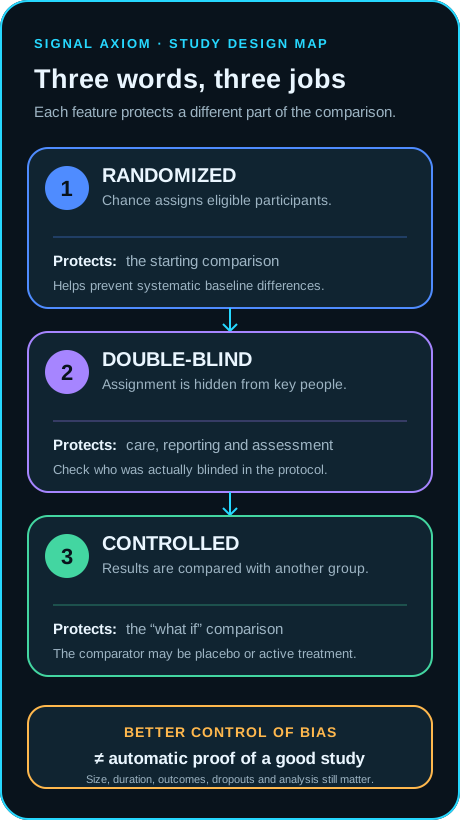
The plain-language takeaway
“Randomized,” “double-blind” and “placebo-controlled” are not three ways to say that a study is good. They describe three different protections. Randomization protects the starting comparison. Blinding protects how people behave, report and judge outcomes. A control group shows what the test treatment is being compared with. Together they can make a result easier to trust, but the actual methods and results still decide how strong the evidence is.
Randomized: protect the starting comparison
In a randomized trial, chance assigns eligible participants to groups. FDA explains that this helps prevent systematic differences in known and unknown starting characteristics. [1] The goal is not to make every individual identical. It is to make the groups comparable enough that a later difference is less likely to be explained by who started in each group. Randomization can still leave chance imbalances, especially in a small study, so the baseline table and planned analysis still matter.
Double-blind: protect behavior and assessment
Blinding—also called masking—keeps treatment assignment hidden from specified people. FDA describes a double-blind trial as one in which participants and relevant investigators or staff do not know the assignment. [1] NIH uses similar plain-language wording for participants and the research team. [2] This can reduce differences in added care, symptom reporting, outcome assessment and interpretation. But the label alone is incomplete: read the methods to learn exactly who was blinded and whether the masking was maintained.
Placebo-controlled: build a useful comparison
A placebo is made to resemble the test treatment but does not contain the test drug. The placebo group helps estimate changes that might occur from the natural course of a condition, expectations, participation in a study, other care or subjective assessment rather than the test treatment itself. [1] That comparison is the main job. A placebo response is not proof that symptoms were imaginary.
Placebo does not always mean no care
In an add-on trial, everyone may receive usual treatment while one group also receives the test treatment and the other receives placebo. FDA notes that no single control type is best in every situation; a trial may instead use no treatment, another regimen or an active treatment. [1] Placebo can be inappropriate when withholding proven therapy would create unacceptable risk. When full blinding is impossible, a blinded outcome evaluator can sometimes protect part of the assessment.
What those three words do not prove
A randomized, double-blind, placebo-controlled trial can still be too small or too short. It can lose many participants, measure an outcome that does not matter to patients, change its main question after seeing data, analyze groups poorly or report results selectively. It also may test a different population, formulation, route or product from the one in a headline or online listing. Design labels reduce specific risks of bias; they do not prove benefit, safety, relevance or product equivalence by themselves.
Five questions to ask next
Ask: Who was randomized? Who was actually blinded? What exactly did the control group receive? Was the main outcome chosen before the study began, and was it measured completely? How many people finished the study, and for how long were they followed? Then check whether the exact product, route and population match the claim you are evaluating. These questions turn an impressive label into a real evidence review.
Practical recap and what remains unknown
Read the three terms as a map: randomization protects the start, blinding protects conduct and assessment, and the control group anchors the comparison. Next read the participant count, duration, prespecified outcome, dropouts, analysis and results. If those details are missing—or if the exact peptide product, formulation or route differs—benefit, long-term safety and applicability remain uncertain.
Publication and source check
This article and graphic were first published October 6, 2026. Sources checked October 6, 2026. FDA trial-design guidance and NIH definitions were checked directly. PeptideDosages.com was reviewed only as an editorial usability reference for how study language appears beside practical peptide content; its wording, graphics, tables and schedules were not copied.
Quick check: A headline says a peptide was tested in a “double-blind, placebo-controlled” trial. Does that prove the peptide works?
No. Those design features can reduce important sources of bias, but you still need the randomization details, sample size, duration, outcome, dropouts, analysis, exact product and route, participant population and actual results. Good design words strengthen a comparison; they are not the result.
Sources
- [1] FDA: E10 Choice of Control Group and Related Issues in Clinical Trials. Published / publicada: 2001-05; checked / revisada: 2026-10-06.
- [2] NIH: The Basics—clinical-trial randomization and double blinding. Checked / revisada: 2026-10-06.
- [3] FDA–NIH: BEST (Biomarkers, EndpointS, and other Tools) Resource—clinical research terminology. Checked / revisada: 2026-10-06.
- [4] PeptideDosages.com: BPC-157 10 mg vial dosage protocol—editorial usability reference only / solo referencia editorial de usabilidad. Checked / revisada: 2026-10-06.