

A few words, made simple
- Lyophilization
- Freeze-drying: water is removed from a frozen product under vacuum through controlled drying steps.
- Sublimation
- A change from solid ice directly to water vapor without first becoming liquid.
- Excipient
- An inactive formulation ingredient, such as a sugar, buffer or stabilizer, included with the active ingredient.
- Reconstitution
- Adding the product-specified liquid to a dry formulation to prepare a solution or suspension.
- Potency
- A tested measure of a product's strength or biological activity. Appearance alone cannot establish it.
- Sterile
- Free from viable microorganisms under validated manufacturing and testing controls—not simply clean-looking.
The plain-language takeaway
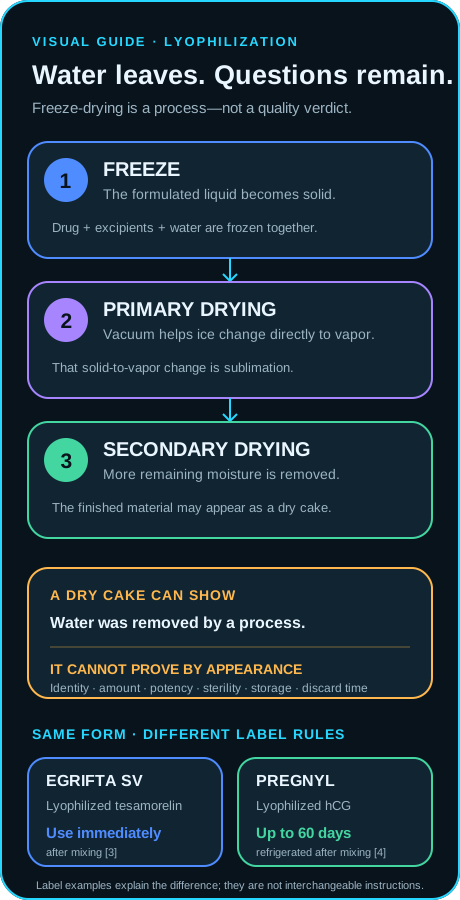
“Lyophilized” describes a manufacturing process. It means a formulated liquid was frozen and water was removed under vacuum to leave a dry product. It does not automatically mean the vial is authentic, accurately filled, potent, sterile, approved, safe at room temperature or suitable for repeated use. Those questions require product-specific labeling, manufacturing controls and test data.
What freeze-drying actually does
FDA describes three linked stages: freezing, primary drying and secondary drying. During primary drying, ice changes directly from solid to vapor under vacuum—a process called sublimation. Secondary drying removes more remaining moisture. [1] Removing water without excessive heat can improve stability for some formulations, but the validated cycle must fit the exact product. “Dry” is the result of a process, not a universal storage promise.
The cake is not only the peptide
A freeze-dried vial can contain the active ingredient plus excipients that support the formulation. For example, the current EGRIFTA SV label lists tesamorelin with mannitol, sucrose, histidine and polysorbate 20. [3] Another product may use a different salt, buffer, sugar, preservative or container. That composition can affect reconstitution, stability and storage. The peptide name or the cake's color cannot reveal the full formula.
Appearance cannot verify identity, amount or sterility
FDA's inspection guide warns that a low fill may not be obvious after lyophilization, especially when the active ingredient is measured in milligrams. It also describes potency, sterility and stability problems that manufacturing controls must prevent. [1] A neat white cake, intact stopper or clear solution after mixing can support a visual check, but none proves identity, correct content, potency or sterility. Those require traceable records and validated testing.
Same dry form, completely different rules
Official labels make the difference concrete. EGRIFTA SV is a preservative-free, single-dose lyophilized tesamorelin product whose label says to use the solution immediately after reconstitution and discard the remainder. [3] PREGNYL is a lyophilized hCG product supplied with a preserved solvent; its label allows refrigerated storage for up to 60 days after reconstitution for one patient. [4] These are label examples, not interchangeable instructions. The exact formulation, diluent, container and intended use explain the different rules.
What to confirm before any calculator
Confirm the exact product name and formulation, total vial content, approved diluent, final liquid volume, storage temperature, light protection, single- or multiple-use status and discard time. Check the lot, expiration date, seal and source documentation. A calculator can divide a confirmed amount by a confirmed volume; it cannot discover missing product instructions or prove what is inside a vial. If required information is missing or conflicting, stop and ask a qualified pharmacist or prescriber rather than guessing.
A dosage form is not human evidence
Lyophilization says nothing about whether a peptide works in people. A cell experiment remains laboratory evidence, an animal experiment remains animal evidence, and a controlled human trial remains human evidence regardless of whether the material began as a dry cake. Freeze-drying can support product manufacturing; it cannot turn an unapproved research peptide into a clinically validated medicine or make a biological claim true.
Practical recap and what remains unknown
Read “lyophilized” as “water was removed from a frozen formulation under controlled conditions.” Then return to the exact label. Do not infer the diluent, mixing volume, storage period, sterility, potency or multi-use status from the dry appearance. Without traceable product documentation and validated testing, identity, content, sterility, stability and clinical relevance remain unknown.
Publication and source check
This article and graphic were first published October 7, 2026. Sources checked October 7, 2026. FDA manufacturing guidance, an FDA-authored regulatory review and current official drug labels were checked directly. PeptideDosages.com was reviewed only as an editorial usability reference for how beginners encounter the word “lyophilized”; its wording, graphics, tables and schedules were not copied.
Quick check: Two vials both contain a white lyophilized cake. Can you assume they use the same diluent and have the same storage and discard rules after mixing?
No. “Lyophilized” identifies a drying process, not a universal formula. The active ingredient, excipients, preservative, container, intended use and validated stability data can differ. Use only the exact product's verified label or qualified instructions; if those are missing, do not guess.
Sources
- [1] FDA: Guide to Inspections of Lyophilization of Parenterals. Published / publicada: 1993-07; checked / revisada: 2026-10-07.
- [2] Rhieu SY, Anderson DD, Janoria K: A regulatory perspective on manufacturing processes pertaining to lyophilized injectable products. AAPS Journal. Published / publicado: 2020-08-02; checked / revisado: 2026-10-07.
- [3] DailyMed: EGRIFTA SV (tesamorelin) official labeling. Checked / revisada: 2026-10-07.
- [4] DailyMed: PREGNYL (chorionic gonadotropin) official labeling. Checked / revisada: 2026-10-07.
- [5] PeptideDosages.com: How to Reconstitute Peptides—editorial usability reference only / solo referencia editorial de usabilidad. Checked / revisada: 2026-10-07.