

A few words, made simple
- Placebo
- A comparison treatment without the active ingredient being studied.
- Randomized
- People are assigned to study groups by chance.
First, everyone received tirzepatide
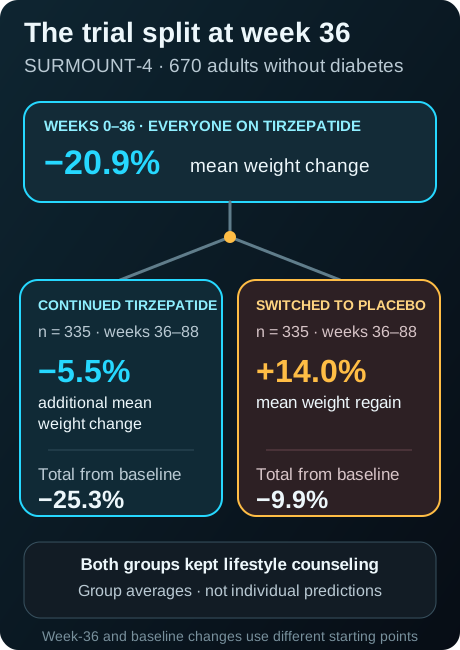
SURMOUNT-4 enrolled 783 adults with obesity or overweight and a weight-related complication, but without diabetes, into a 36-week open-label tirzepatide lead-in. The 670 people who completed that period and reached a tolerated study dose lost 20.9% of body weight on average. That first phase matters: the randomized population had already remained in treatment long enough to reach week 36, so it does not represent everyone who starts the medicine. [1, 2]
Then the study changed one variable
At week 36, investigators randomly assigned 335 participants to continue tirzepatide and 335 to switch to matching placebo for 52 more weeks. Participants and investigators were blinded, and both groups continued diet and physical-activity counseling. From week 36 to 88, the continuation group lost another 5.5% on average, while the placebo group regained 14.0%. From the original baseline, the average reductions at week 88 were 25.3% and 9.9%, respectively. [1, 2]
Maintenance was a measured outcome
At week 88, 89.5% of participants who continued tirzepatide had maintained at least 80% of the weight reduction achieved during the lead-in period, compared with 16.6% of those switched to placebo. This was a randomized withdrawal experiment, not a test of who wanted the result more. The contrast shows that ongoing treatment materially affected maintenance under the study conditions. It does not say that every person will follow either group average. [1, 2]
The later analysis adds context, not a second trial
A later post hoc analysis focused on 308 people in the withdrawal group who had lost at least 10% by week 36. Within one year, 254 people, or 82.5%, regained at least one-quarter of that initial reduction. Greater regain was associated with greater reversal of improvements in waist circumference, blood pressure, non-HDL cholesterol, glucose measures and insulin resistance. Because participants were grouped by what happened after withdrawal rather than randomly assigned to a regain category, these subgroup associations are exploratory. The trial and follow-up analysis were sponsored by Eli Lilly. [3]
What the trial does not decide
SURMOUNT-4 does not provide a universal stopping plan, predict what happens beyond week 88 or establish the same result in people with diabetes, at other doses or with a different finished product. It studied a defined human medicine under a protocol; it did not test animal models, laboratory tissue, compounded mixtures or research-labeled vials. No animal or laboratory result is being used here as a human outcome. Decisions about starting, continuing or stopping treatment require a licensed clinician and verified product information. A calculator cannot make that decision.
Publication and source check
This article and graphic were first published September 26, 2026. Sources checked September 26, 2026. The randomized trial was published online December 11, 2023 and appeared in the January 2024 issue of JAMA. The post hoc analysis was published online November 24, 2025 and appeared in the February 2026 issue of JAMA Internal Medicine. This article explains human research and does not provide a personal dosing or withdrawal protocol.
Before applying a study to yourself, what should you check?
Check who or what was studied, which product was used, what it was compared with, and what actually changed. A laboratory finding or a change in a measured marker does not automatically establish a benefit for people. Use the sources below to check those details.
Sources
- [1] Aronne et al.: SURMOUNT-4 randomized withdrawal trial / ensayo aleatorizado de retirada. Online / en línea: 2023-12-11; journal / revista: 2024-01.
- [2] Full SURMOUNT-4 report in JAMA / informe completo de SURMOUNT-4 en JAMA. DOI: 10.1001/jama.2023.24945
- [3] Horn et al.: post hoc cardiometabolic analysis / análisis cardiometabólico post hoc. Online / en línea: 2025-11-24; journal / revista: 2026-02.