

A few words, made simple
- Biomarker
- A measured sign in the body. A change does not by itself prove someone feels or functions better.
- Randomized
- People are assigned to study groups by chance.
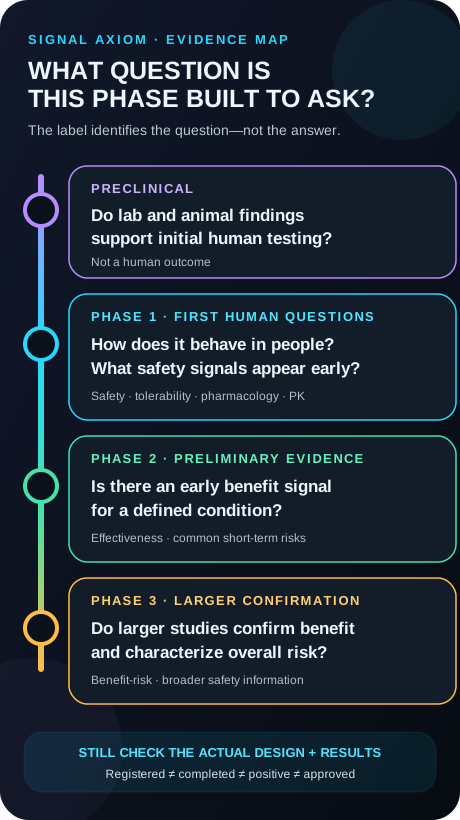
A phase label describes the research question
Clinical development is not a four-step confidence meter. Each phase is designed around different objectives, participants, measurements and uncertainties. FDA describes a typical progression from early, small Phase 1 studies to larger Phase 3 studies, but a phase number alone does not reveal whether the trial was randomized, adequately controlled, completed, published or positive. Read the design and results—not just the badge. [1]
Preclinical evidence supports a decision to test—not a human outcome
Laboratory and animal studies can investigate biological activity, pharmacology and toxicity before initial human exposure. FDA explains that preclinical work is used to support a judgment that it is reasonably safe to proceed to human trials. [2] That is an important gate, but a cell response, wound model or change in an animal biomarker is not evidence that a person will feel better, function better or live longer. Translation to humans remains an unanswered question.
Phase 1 is usually about safety, tolerability and human pharmacology
Phase 1 is the initial introduction of an investigational drug into people. FDA says these closely monitored studies commonly examine metabolic and pharmacologic actions, how the body handles the product, and side effects associated with increasing exposure; they may collect early effectiveness information when possible. [1,2] A small Phase 1 signal can justify the next study, but it generally cannot establish a treatment benefit, define uncommon risks or validate an online dosing schedule.
Phase 2 looks for preliminary effectiveness in a defined condition
Phase 2 studies usually enroll people with the disease or condition being studied. Their job is to obtain preliminary effectiveness data and add information about common short-term side effects and risks. [2] The exact population, comparator, route, formulation, endpoint, duration and missing data still determine what the result means. A positive biomarker or a dose-selection signal is not automatically proof of a patient-important benefit.
Phase 3 tests benefit and risk at a larger scale
Phase 3 studies generally follow preliminary evidence suggesting effectiveness. FDA describes them as expanded trials intended to gather the additional effectiveness and safety information needed to evaluate the overall benefit-risk relationship. [2] Larger and longer studies can reveal effects that smaller trials miss, but “Phase 3” still does not guarantee success, approval, broad applicability or long-term certainty. The actual protocol and results remain decisive.
Registered does not mean completed, and completed does not mean positive
A ClinicalTrials.gov record is a study record, not proof that the planned work produced a benefit. Check recruitment status, actual enrollment, completion dates, posted results, primary outcomes, adverse events and linked publications. ClinicalTrials.gov lists Early Phase 1, Phase 1, Phase 2, Phase 3, Phase 4 and Not Applicable as record fields; that classification should be read together with the rest of the record. [3] A planned or registered peptide study cannot validate a route, formulation or regimen that it did not test.
A five-line check before repeating a phase claim
Identify the exact molecule and finished product; confirm the route and formulation; name the population and sample size; read the prespecified primary outcome and study status; then separate safety, pharmacokinetics, biomarkers and patient-important outcomes. If results are not posted or published, say that plainly. PeptideDosages.com was reviewed only to identify the recurring usability problem of phase labels being placed beside protocol math; the evidence rules here come from FDA and ClinicalTrials.gov sources. [1–4]
Evidence boundary
This guide explains how to interpret development phases. It does not judge a specific trial, verify a product, recommend participation, select a dose or create a treatment protocol. No laboratory or animal finding is presented as a human outcome. An investigational product's risks, eligibility rules and alternatives require discussion with the study team and a licensed clinician.
Publication and source check
This article and graphic were first published October 2, 2026. Sources checked October 2, 2026. FDA's current clinical-research and drug-development definitions were checked directly, along with current ClinicalTrials.gov study-record definitions. PeptideDosages.com was used only as an editorial topic and usability reference; its protocol tables and wording were not copied.
Before applying a study to yourself, what should you check?
Check who or what was studied, which product was used, what it was compared with, and what actually changed. A laboratory finding or a change in a measured marker does not automatically establish a benefit for people. Use the sources below to check those details.
Sources
- [1] FDA: Step 3—Clinical Research / Paso 3: investigación clínica. Checked / revisada: 2026-10-02.
- [2] FDA: Drug Development and Review Definitions / definiciones de desarrollo y revisión. Checked / revisada: 2026-10-02.
- [3] ClinicalTrials.gov: Protocol Registration Data Element Definitions / definiciones de elementos del registro. Checked / revisada: 2026-10-02.
- [4] PeptideDosages.com: BPC-157 10 mg protocol page—editorial usability reference only / solo referencia editorial de usabilidad. Checked / revisada: 2026-10-02.