

A few words, made simple
- Mechanism of action
- The biological steps proposed to explain how a product produces an effect, such as interacting with a receptor and changing a signal.
- Receptor
- A protein that can recognize a molecule and begin or alter a biological signal. Binding to a receptor does not guarantee a useful clinical effect.
- In vitro
- Studied outside a living organism, for example in cells or a laboratory assay.
- Clinical outcome
- A result that describes how people feel, function or survive, or an important health event such as hospitalization.
The plain-language takeaway
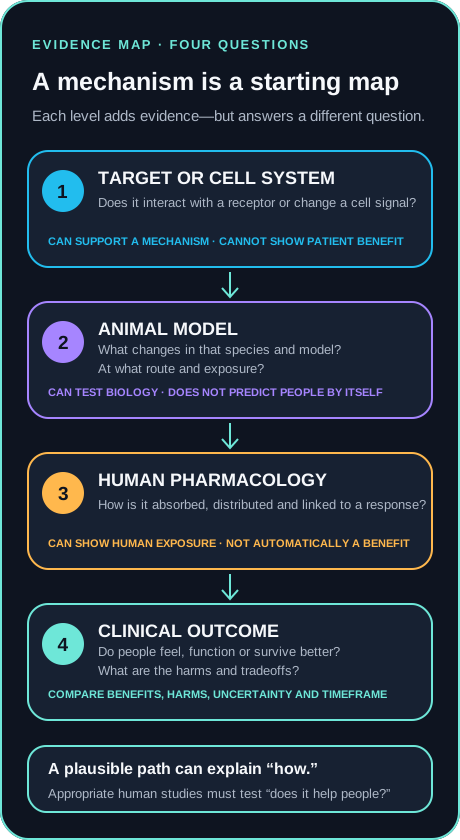
A mechanism is a biological explanation for how something might work. It can make a hypothesis plausible and help researchers choose what to measure next. It is not the same as evidence that a particular product helps people. FDA separates preclinical research—which includes laboratory and animal work—from clinical research done in people, and says preclinical work is not a substitute for studying how a drug interacts with the human body. [1,2]
Start with the exact claim
“Binds receptor X,” “changes a signal in cultured cells,” “improves a measurement in mice” and “improves symptoms in people” are four different claims. One may support the next research question, but none automatically proves the others. Before accepting a headline, rewrite it as a sentence that names the model, the measured outcome and the product or formulation tested.
Cells can test a pathway—not a whole person
A cell assay can show that a molecule interacts with a target under controlled conditions. That is useful mechanistic evidence. But a person also has digestion or injection-site factors, circulation, metabolism, immune responses, multiple organs and many interacting signals. The concentration used in a dish may not be achievable or safe in humans. Read an in-vitro result as “this happened in this system at this exposure,” not “this treatment works in people.”
Animal findings add context, not certainty
Animal studies can examine a living system and explore distribution, toxicity and physiology before human testing. FDA describes preclinical studies as a way to answer basic safety questions and decide whether testing in people should proceed. [1] Species biology, the disease model, route, formulation and exposure can all differ from the human situation. An animal result should therefore remain labeled as animal evidence even when the mechanism sounds relevant to humans.
Human exposure is still not the same as human benefit
Early human studies may measure pharmacokinetics—what the body does to a product—or pharmacodynamics—what measurable biological response follows exposure. Those results can confirm that a product reaches people and affects a pathway. They still may not answer whether people feel better, function better, avoid hospitalization or live longer. ICH E8(R1) distinguishes human pharmacology, exploratory, confirmatory and post-approval studies because each type has different objectives. [3]
Clinical results require the right comparison
To test benefit, look for an appropriate human study that measures a meaningful outcome over a relevant timeframe and compares groups in a way that reduces bias. Then read effect size, uncertainty, harms, withdrawals and who was studied. FDA's final effectiveness guidance explains that sound evidence of effectiveness is a central part of benefit-risk assessment and focuses on adequate, well-controlled clinical investigations. [4] A beautiful mechanism cannot repair a weak comparison.
A five-line evidence check
Write down: (1) the exact product and formulation; (2) the system studied—target, cells, animal or people; (3) the exposure and route; (4) the measured outcome; and (5) what the study did not test. This simple note prevents a laboratory signal from quietly turning into a human promise. For a research peptide with only mechanistic or animal evidence, human benefit, long-term safety, effective exposure and product quality can all remain unknown.
Practical recap and what remains unknown
Mechanistic, cell and animal findings are valuable when they are described accurately. They tell researchers where to look; they do not guarantee what a person will experience. Match every conclusion to the evidence level that produced it, and keep the unknowns visible until appropriate human studies answer them. This article explains evidence interpretation, not a treatment recommendation or dosing protocol.
Publication and source check
This article and graphic were first published October 10, 2026. Sources checked October 10, 2026. FDA's preclinical, clinical-research and final effectiveness guidance, plus ICH E8(R1), were reviewed directly. FDA also issued a revised draft effectiveness guidance in June 2026; because it is marked draft and not for implementation, it was not used as the final standard here. PeptideDosages.com was reviewed only as an editorial usability reference for how mechanism explanations are presented; its wording, tables, graphics and protocols were not copied.
Quick check: A peptide activates a receptor in cultured cells. What has the study shown?
It has shown a target interaction or signal in that laboratory system at the tested exposure. It has not, by itself, shown absorption, safe exposure, symptom improvement or clinical benefit in people.
Sources
- [1] FDA: Step 2—Preclinical Research. Page dated / página fechada: 2018-01-04; checked / revisada: 2026-10-10.
- [2] FDA: Step 3—Clinical Research. Page dated / página fechada: 2018-01-04; checked / revisada: 2026-10-10.
- [3] ICH E8(R1): General Considerations for Clinical Studies. Step 4 adopted / adoptada: 2021-10-06; checked / revisada: 2026-10-10.
- [4] FDA: Providing Clinical Evidence of Effectiveness for Human Drug and Biological Products. Final guidance / guía final: 1998-05; checked / revisada: 2026-10-10.
- [5] PeptideDosages.com Beginner's Guide—editorial usability reference only / solo referencia editorial de usabilidad. Checked / revisada: 2026-10-10.