

A few words, made simple
- Endogenous
- Made naturally inside the body. Endogenous describes origin; it does not by itself describe a product's safety or effectiveness.
- Analog
- A designed molecule that is similar to a natural molecule but has one or more deliberate differences.
- Exposure
- How much of a substance reaches the body over time. Route, absorption, distribution and clearance all affect exposure.
- Formulation
- The complete prepared product: active ingredient, concentration, inactive ingredients, dosage form, container and instructions.
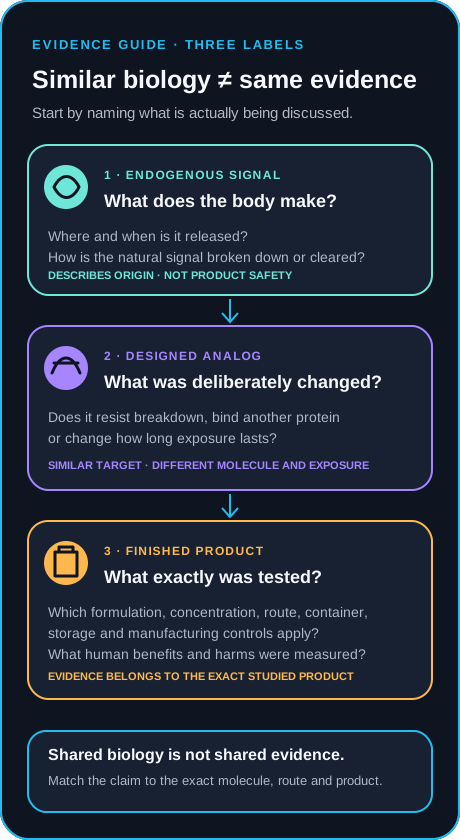
The plain-language takeaway
Your body makes many peptides, but that fact does not make every peptide product equivalent to the body's own signal. A natural peptide, a designed analog and a finished product answer different questions. To judge a claim, identify which one is actually being discussed and match the evidence to the exact molecule, formulation, route, population and outcome studied.
Endogenous describes where a signal begins
An endogenous peptide is made inside the body, often released in a specific place and moment, then broken down or cleared. Those controls shape the signal. The word endogenous does not tell you what happens when a manufactured substance is delivered from outside the body, at a different route or exposure. It is a biology label—not a guarantee of safety, purity or benefit.
An analog is similar by design—not identical
Researchers can change parts of a peptide to resist breakdown, bind another protein, reach a target differently or last longer. That designed molecule is an analog. Similarity can preserve useful receptor activity while the changes alter exposure and other properties. The correct question is not simply “Is it natural?” but “What was changed, what did that change do, and what evidence exists for this exact analog?”
A concrete example: native GLP-1 and semaglutide
Human research showed that GLP-1 is rapidly degraded after administration. [2] The current Ozempic label describes semaglutide as a GLP-1 analog with 94% sequence homology to human GLP-1. It also describes deliberate modifications that reduce DPP-4 breakdown and promote albumin binding, producing an elimination half-life of about one week. [1] This is a useful example of shared receptor biology with very different persistence. It does not mean that evidence for the labeled product transfers to every vial or product that uses the word semaglutide.
The finished product adds another evidence layer
A finished product includes more than the active molecule. Concentration, inactive ingredients, sterility, container, route, storage, manufacturing controls and instructions can all matter. The current Ozempic label specifies the semaglutide product, its formulations, route and clinical evidence. [1] A differently prepared product must be assessed on its own identity and quality; a shared ingredient name is not a complete bridge.
Approval and compounding are product-specific
FDA explains that unapproved GLP-1 versions do not undergo its premarket review for safety, effectiveness and quality. It also notes that compounded drugs may be appropriate for particular medical needs but are not FDA approved, and that semaglutide salt forms are different active ingredients from the one used in approved drugs. [3] This does not make every compounded product the same or automatically inappropriate. It means the status and evidence of one product should not be silently assigned to another.
A three-question check
First: is the claim about a peptide made by the body? Second: is it about a specific designed analog? Third: is it about a finished product with a confirmed formulation and source? Then ask whether the cited human study used that exact product, route and population. ICH E8(R1) emphasizes that study design, participants, treatment, outcomes and conduct determine what a clinical study can establish. [4] If the exact product is unknown, product quality and clinical relevance remain unknown too.
Practical recap and what remains unknown
“The body makes something similar” is a reason to study a pathway, not a finished safety conclusion. Keep three labels separate: endogenous signal, designed analog and exact product. For an unverified research vial, identity, concentration, sterility, exposure, human benefit, harms and long-term effects may all remain uncertain. This article teaches evidence matching; it is not a treatment recommendation or dosing protocol.
Publication and source check
This article and graphic were first published October 11, 2026. Sources checked October 11, 2026. The June 2026 Ozempic label, the original 1995 human GLP-1 metabolism study, FDA's current unapproved-GLP-1 guidance and ICH E8(R1) were reviewed directly. PeptideDosages.com was reviewed only as an editorial usability reference for how semaglutide information is organized; its wording, tables, graphics and protocols were not copied.
Quick check: A seller says a research vial is safe because the body naturally makes a peptide that uses the same receptor. What is missing?
Evidence for the exact molecule and product: confirmed identity, formulation, concentration, sterility and manufacturing quality, plus appropriate human data for that route, exposure, population, benefits and harms. Shared receptor biology alone cannot supply those answers.
Sources
- [1] DailyMed/FDA label: Ozempic (semaglutide) injection. Revised / revisada: 2026-06; checked / consultada: 2026-10-11.
- [2] Deacon CF et al. Both subcutaneously and intravenously administered GLP-1 are rapidly degraded in humans. Diabetes. Published / publicado: 1995-09; checked / consultado: 2026-10-11.
- [3] FDA: Concerns with unapproved GLP-1 drugs used for weight loss. Checked / consultada: 2026-10-11.
- [4] ICH E8(R1): General Considerations for Clinical Studies. Step 4 adopted / adoptada: 2021-10-06; checked / consultada: 2026-10-11.
- [5] PeptideDosages.com semaglutide page—editorial usability reference only / solo referencia editorial de usabilidad. Checked / consultada: 2026-10-11.