
A few words, made simple
- Indication
- The specific medical use and patient group described in a medicine's approved label.
- Intermediate clinical endpoint
- A measured clinical change considered reasonably likely to predict a meaningful patient benefit, before that benefit is fully verified.
- Open-label extension
- Additional study follow-up in which participants and researchers know which treatment is being given.
- Confirmatory trial
- A study designed to verify and describe the clinical benefit predicted by the earlier evidence.
The plain-language takeaway
Forzinity has a real U.S. approval for a specific use—not a blanket approval of every claim about SS-31. Accelerated approval allows earlier access while an important predicted benefit still needs confirmation.
Start with the exact approval
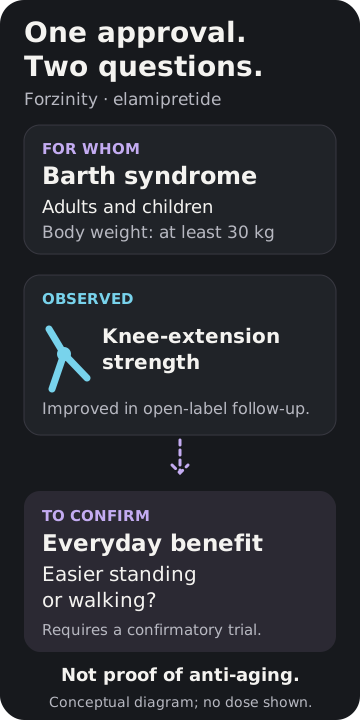
On September 19, 2025, the U.S. Food and Drug Administration (FDA) granted Forzinity, the elamipretide medicine, accelerated approval to improve muscle strength in adults and children with Barth syndrome weighing at least 30 kilograms. Barth syndrome is a rare, serious mitochondrial disease; mitochondria are the energy-producing parts of cells. [1,2] This is a defined disease, product and patient group—not an approval for general fatigue, athletic performance or anti-aging.
What accelerated approval means
This pathway can support earlier approval for serious conditions with unmet medical needs using a measure reasonably likely to predict patient benefit. It does not mean “no evidence,” and it does not mean every important benefit has already been confirmed. Further studies must verify the predicted benefit; if they do not, FDA has procedures that can lead to withdrawal. [4]
Keep the two study periods separate
In the original small human trial, 12 participants received elamipretide and placebo in separate blinded treatment periods. After 12 weeks of treatment, the drug was not superior to placebo on the two primary outcomes: walking distance in six minutes and a fatigue score. Later open-label follow-up reported improvements, including knee-extension strength. [3] An uncontrolled follow-up does not provide the same comparison as the blinded placebo period. Mixing the two into one “positive trial” headline hides that distinction.
The bridge still being tested
The approval rests on improved strength in the muscle used to straighten the knee, an intermediate clinical endpoint. FDA considered that reasonably likely to predict benefits such as easier standing or walking. [1] Its current ongoing-approval list still requires a randomized, double-blind, placebo-controlled confirmatory trial in Barth syndrome. [5] A knee-strength measurement and a verified everyday functional benefit are related questions, not identical answers.
Do not stretch the evidence—or ignore the risks
These are human data in Barth syndrome. Animal and laboratory findings about mitochondrial biology do not turn them into proof of anti-aging benefit in healthy people. A research vial labeled SS-31 is not established as interchangeable with the approved Forzinity product. The label also describes injection-site reactions and potentially serious hypersensitivity. [2] Approval is not a promise of zero risk; individual treatment decisions belong with a qualified clinician.
Practical recap and what remains unknown
When you read “FDA-approved,” ask: which product, for whom, for what outcome, and through which pathway? Here, the approval is specific and the confirmatory question remains important. The size and durability of the predicted functional benefit still need verification. This article does not supply a dose, validate another formulation or establish benefits outside the labeled use.
Publication and source check
First published October 15, 2026; sources checked October 15, 2026. The current posted Forzinity label remains revised September 2025. FDA's current ongoing accelerated-approval list and the original trial paper were checked directly. PeptideDosages.com's SS-31 page was used only as an editorial usability reference for separating a research-vial page from an approved product; no wording, tables, graphics or protocols were copied.
Quick check: Does Forzinity's approval prove that an SS-31 research vial improves everyday energy in a healthy adult?
No. The approval concerns a specific medicine and muscle-strength indication in Barth syndrome at the labeled weight threshold. It does not establish a healthy-adult energy benefit or interchangeability with a research vial. The predicted patient benefit within the approved indication also has a required confirmatory trial.
Sources
- [1] FDA: Accelerated approval of Forzinity for Barth syndrome. Published / publicado: 2025-09-19; checked / consultado: 2026-10-15.
- [2] FORZINITY prescribing information, sections 1, 5, 6 and 14. Revised / revisada: 2025-09; current DailyMed posting updated / publicación vigente actualizada: 2025-12-10; checked / consultada: 2026-10-15.
- [3] Thompson WR et al. Randomized trial and open-label extension of elamipretide in Barth syndrome. Genetics in Medicine. First published online / primera publicación en línea: 2020-10-20; 2021;23:471–478. Checked / consultado: 2026-10-15.
- [4] FDA: Accelerated Approval Program. Current page checked / página vigente consultada: 2026-10-15.
- [5] FDA: Ongoing accelerated approvals—non-malignant hematological, neurological and other disorders. Forzinity requirement 4802-1. Current list checked / lista vigente consultada: 2026-10-15.
- [6] PeptideDosages.com SS-31 10 mg page—editorial usability reference only / solo referencia editorial de usabilidad. Published / publicada: 2026-03-01; updated / actualizada: 2026-10-04; checked / consultada: 2026-10-15.