

A few words, made simple
- Clinical outcome
- A result about how people feel, function or survive.
- Placebo
- A comparison treatment without the active ingredient being studied.
- Randomized
- People are assigned to study groups by chance.
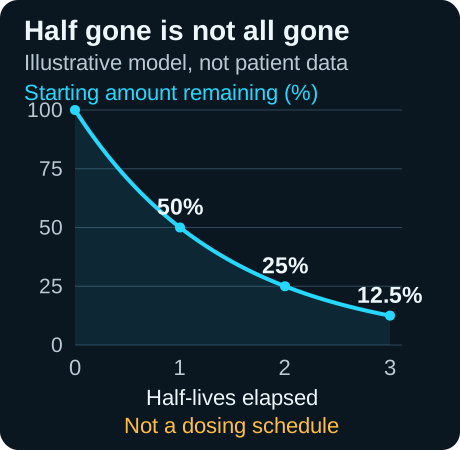
Half gone is not all gone
Half-life describes how long it takes for a quantity to fall by half. For a medicine, the reported value may describe a particular phase of its concentration decline. It is not an expiration date for its effects. In the simple model above, each equal interval halves what remains: 100%, then 50%, then 25%, then 12.5%. It does not subtract 50 percentage points each time. These are calculated teaching values, not measurements from people.
A human example: different measurements, different clocks
Teichman and colleagues studied long-acting CJC-1295 in two randomized, placebo-controlled trials lasting 28 and 49 days in healthy adults aged 21 to 61. They estimated a drug half-life of 5.8 to 8.1 days. After a single administration, growth hormone remained elevated for at least 6 days and IGF-1 for 9 to 11 days. Drug levels and hormone responses were separate measurements, not interchangeable clocks. [1]
What those findings do not establish
Those were human pharmacology studies, not animal experiments, but hormone changes alone do not establish improved muscle growth, recovery or long-term safety. FDA's 2024 evaluation separately reviews laboratory, animal and human evidence and distinguishes CJC-1295 with DAC from forms without DAC. Their names are not permission to transfer a half-life or a schedule between them. Animal or laboratory findings also cannot supply a missing human regimen. [2]
Use this three-question check
Before trusting a half-life claim, ask: Was it measured in humans using this exact compound and route? Does the number describe the compound itself, a hormone response or a clinical outcome? Was the proposed schedule actually tested for the intended use? If the answers are missing, the half-life cannot fill those gaps. A calculator can convert confirmed amounts and concentrations; it cannot turn persistence in the body into an appropriate dose, timing or cycle.
Publication and source check
This article and graphic were first published September 24, 2026. Sources checked September 24, 2026. The CJC-1295 paper was first published online December 13, 2005, and appeared in the March 2006 journal issue. The FDA evaluation is dated November 15, 2024, for the December 4, 2024 advisory meeting. These are established references, not a newly announced trial.