

A few words, made simple
- Clinical outcome
- A result about how people feel, function or survive.
- Placebo
- A comparison treatment without the active ingredient being studied.
What the new records study found
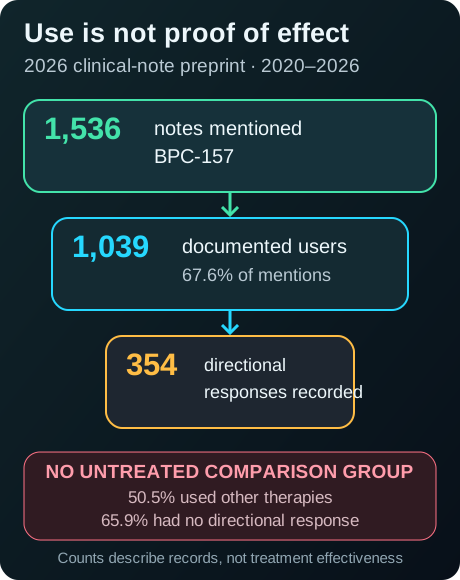
A September 2026 preprint searched de-identified clinical notes from a U.S. health-record network covering 2020 through 2026. Of 1,536 people with a note mentioning BPC-157, reviewers confirmed documented use in 1,039. Newly confirmed users increased 33-fold from the first quarter of 2020 to the first quarter of 2026. This is useful evidence that use is being documented more often. It is not evidence that BPC-157 caused a health benefit. [1]
Read the 79% claim with its denominator
A directional response was available for 354 of the 1,039 documented users. Among that subgroup, 79% had a note describing symptomatic improvement. Response direction was unavailable for 685 users, or 65.9%. In addition, 50.5% of users had another therapeutic agent documented, and some also had physical therapy, surgery or other interventions. Without an untreated comparison group, standardized outcomes or control of co-treatments, the notes cannot separate a BPC-157 effect from recovery over time, other care, placebo effects or reporting bias. [1]
The human evidence is still early
A May 2026 review found fewer than 30 participants across three small, uncontrolled human pilot studies. The studies used different routes and did not use a standardized pharmaceutical preparation. The review found no completed phase 2 trial, no validated dosing regimen and no approved formulation. A separate 2026 laboratory study exposed human artery segments obtained during surgery to BPC-157 and observed relaxation responses. That is human tissue research, not treatment of living patients or proof of a clinical outcome. [2, 3]
Promising animal work stays in the animal box
In a 2006 experiment, researchers detached and surgically repaired the Achilles tendons of rats, then compared several BPC-157 treatment groups with control groups. Measures of tendon healing improved in treated rats. That study supports a preclinical research question. It did not test a retail vial, a self-directed schedule or recovery in people. Animal findings can justify better human trials, but they cannot supply the missing human comparison by themselves. [4]
Use this five-part evidence check
Ask five questions before treating an online protocol as evidence: Was there a comparison group? Was the exact finished product verified? Were route and formulation the same? Were outcomes defined before treatment and measured for everyone? Could other treatments explain the result? If those answers are missing, a clean-looking dosage chart does not fill the gaps. Signal Axiom can explain study context and calculate from confirmed label information, but it does not turn observational notes or animal results into a personal protocol.
Publication and source check
This article and graphic were first published September 25, 2026. Sources checked September 25, 2026. The health-record report was posted as a preprint September 7, 2026 and had not completed peer review when checked. The pharmaceutical review was published May 20, 2026, the human artery laboratory study May 7, 2026 and the rat Achilles-tendon study in 2006. This article separates study types and does not provide a dosing or treatment protocol.
Before applying a study to yourself, what should you check?
Check who or what was studied, which product was used, what it was compared with, and what actually changed. A laboratory finding or a change in a measured marker does not automatically establish a benefit for people. Use the sources below to check those details.
Sources
- [1] Venkatakrishnan et al.: U.S. clinical-note study / estudio de notas clínicas en EE. UU. Preprint / prepublicación: 2026-09-07. DOI: 10.20944/preprints202609.0501.v1
- [2] Mateescu et al.: BPC-157 pharmaceutical development review / revisión del desarrollo farmacéutico. Published / publicado: 2026-05-20.
- [3] Yildirim et al.: BPC-157 in isolated human artery tissue / BPC-157 en tejido arterial humano aislado. Published / publicado: 2026-05-07.
- [4] Staresinic et al.: rat Achilles-tendon experiment / experimento del tendón de Aquiles en ratas (2006).